
Customer Experience Is Not a Department

Customer Experience Is Not a Department
For marketers, it is easy to think about customer experience in terms of touchpoints: the campaign, the landing page, the form, the follow-up email, the service script. Each of those moments matters. But customer experience is not built through isolated interactions. It is shaped across the full journey.
That idea is at the center of, “Customer Experience Orientation: Conceptual Model, Propositions, and Research Directions” by Farah Arkadan, Emma K. Macdonald and Hugh N. Wilson, published in the Journal of the Academy of Marketing Science.
The researchers studied how organizations actually manage customer experience from the inside. Their research looked at nine organizations actively working on customer experience, using interviews with leaders and managers, company materials, observations and site visits. Instead of only asking how customers feel, the study examined what organizations believe, how teams behave and how customer experience becomes part of the way work gets done.
The researchers found that strong customer experience depends on what they call a customer experience orientation: a set of values and behaviors that help the whole organization learn from customers, improve the journey and connect the experience back to purpose.
For marketers, the first takeaway is to stop looking only at isolated interactions.
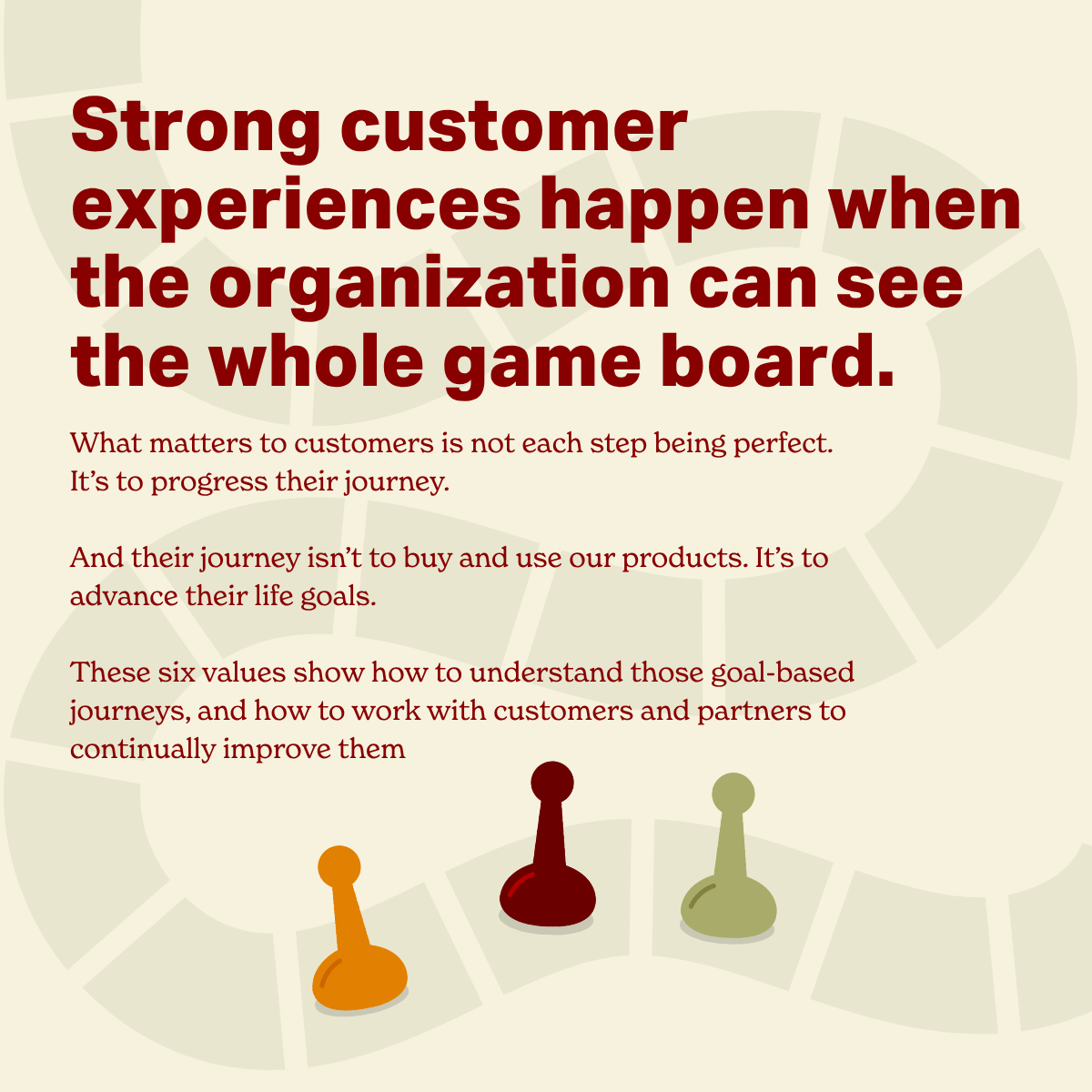
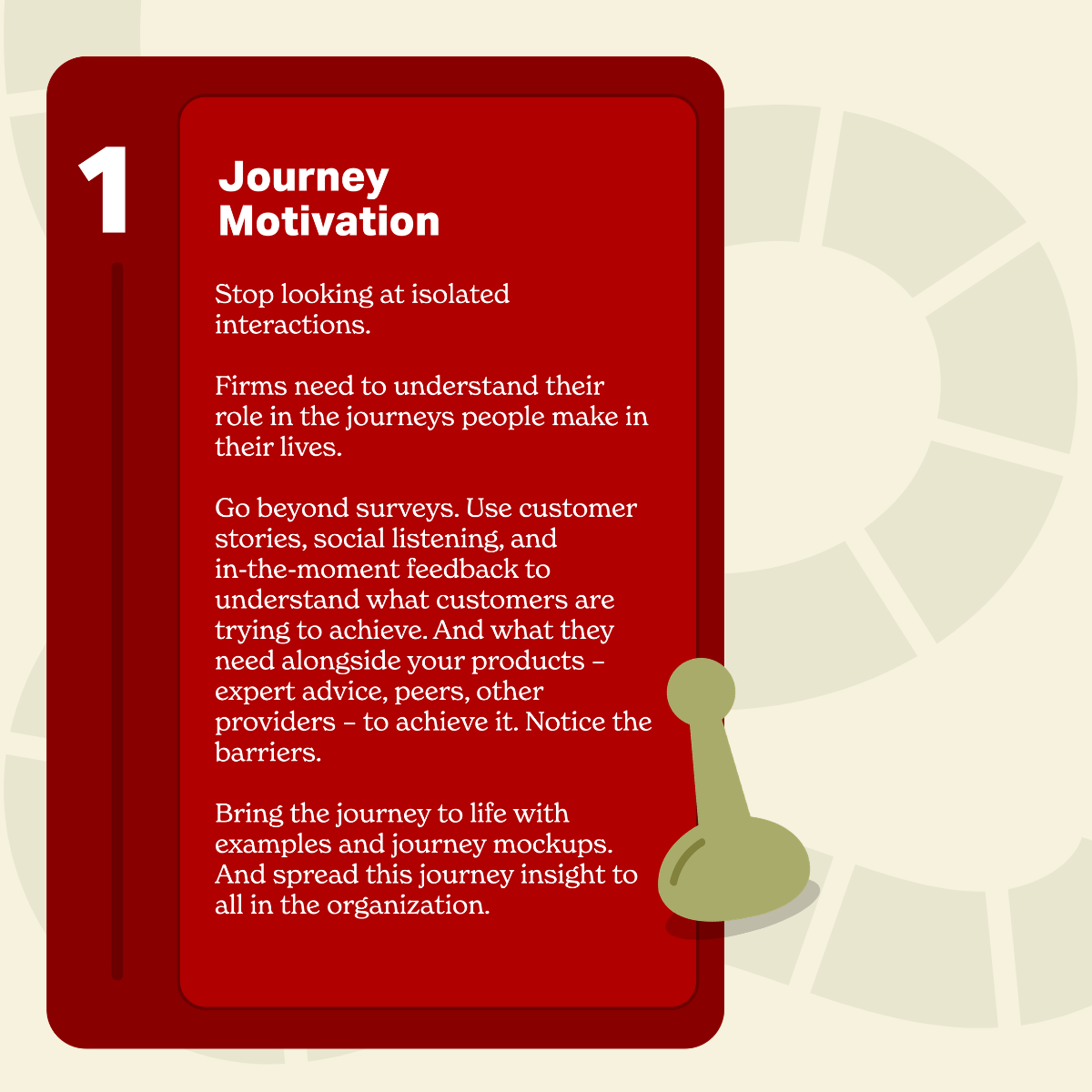

Customers understand a brand as one connected path, not as separate departments or channels. That path includes the moments the organization controls, such as a website or sales conversation, and the moments it does not, such as reviews, social mentions, peer recommendations and the customer’s own context. Understanding the journey requires more than surveys. It requires listening for what customers are trying to accomplish, how they feel in the moment and where the experience becomes easier or harder than expected.
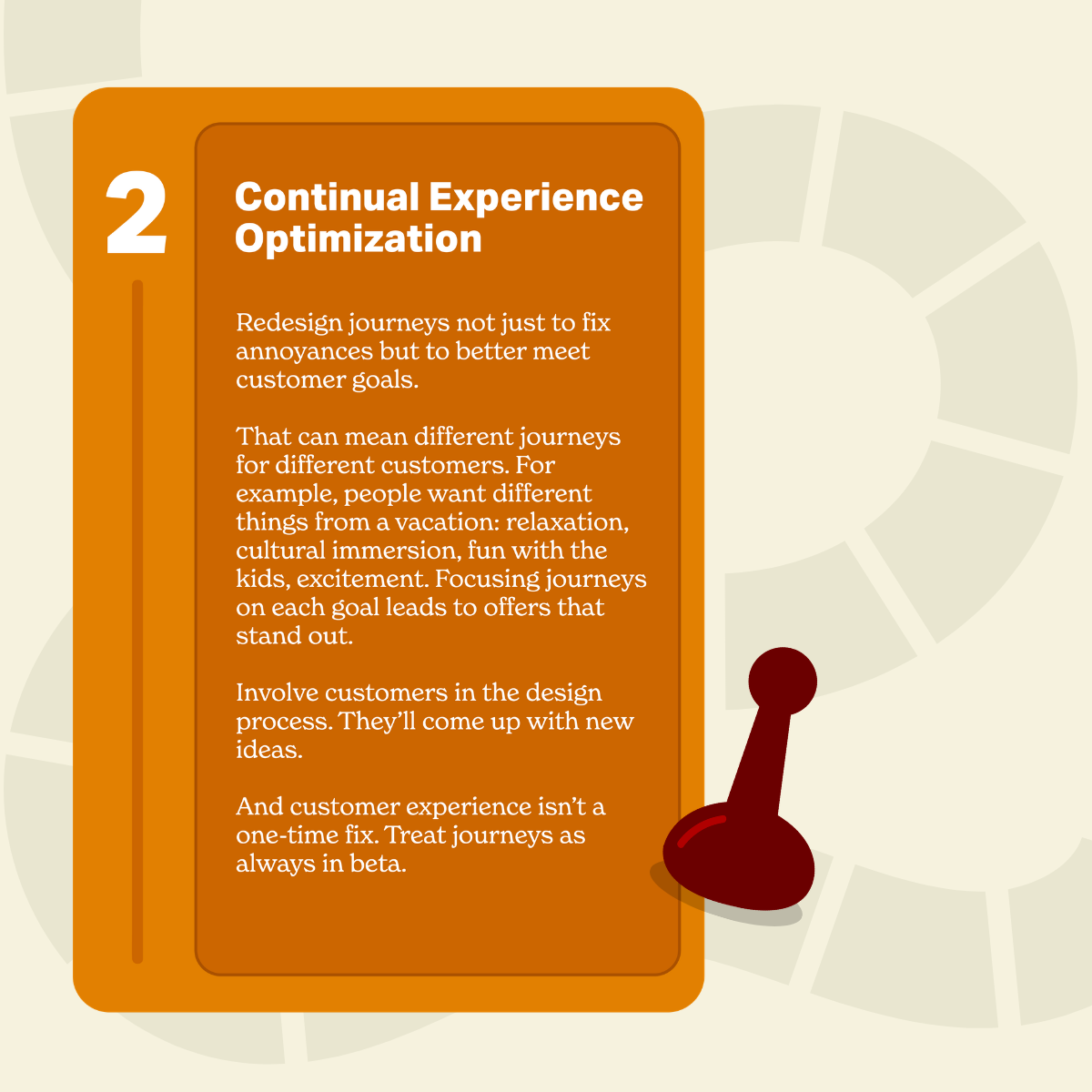
The second takeaway is that customer experience is never finished. The strongest organizations keep improving individual touchpoints and the full journey over time. For marketers, that means paying attention to the small moments that shape how the brand feels: clearer language, fewer clicks, better follow-up, smoother handoffs, stronger onboarding and more useful support. These improvements may seem tactical, but together they can make the experience feel more connected, helpful and trustworthy.
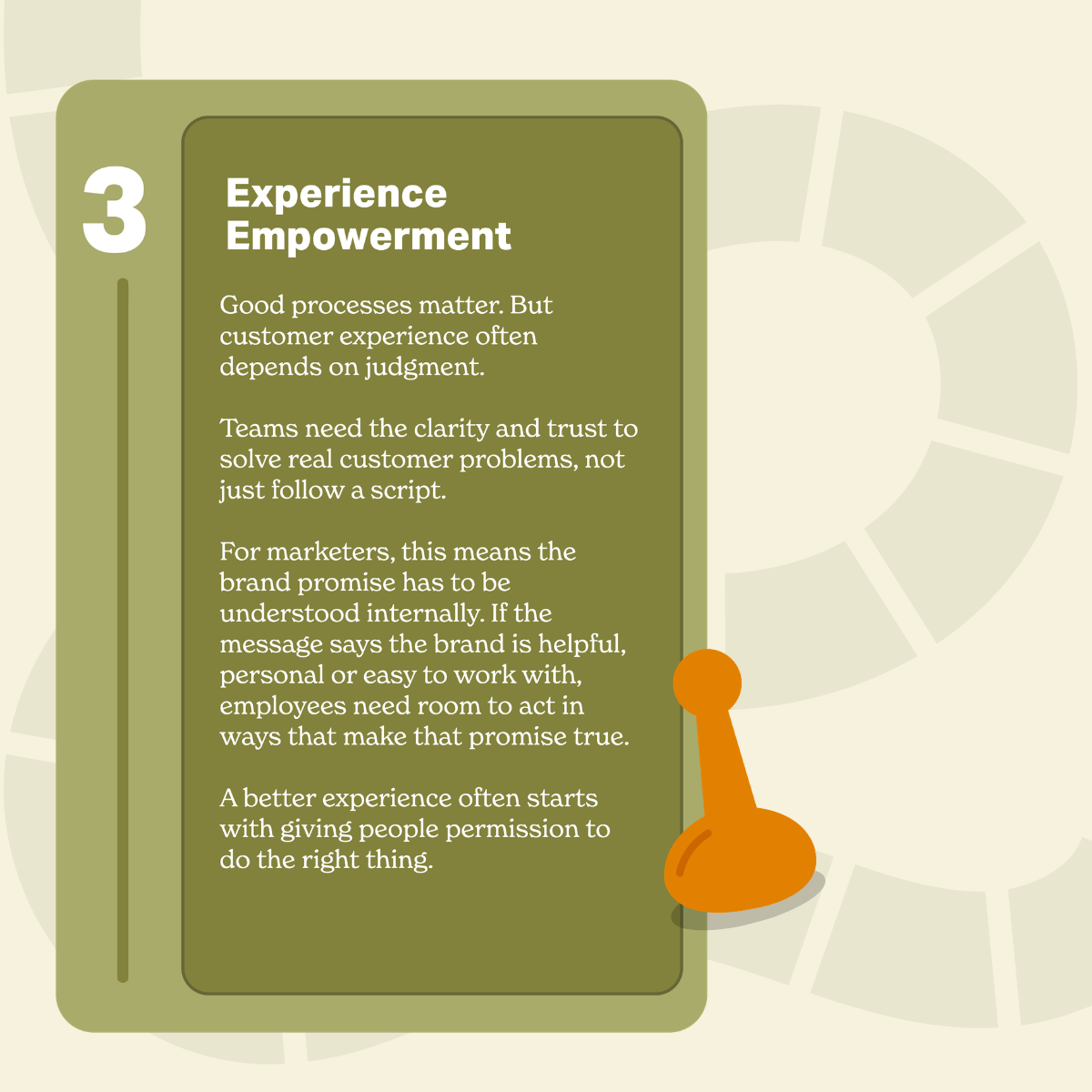
The third takeaway is that people need the ability to act. Good processes matter, but real customer needs do not always fit neatly into a script. The research highlights the importance of empowering employees to use judgment in service of the customer experience. For marketers, this means the brand promise has to be understood inside the organization. If the message says the brand is responsive, personal or easy to work with, teams need enough clarity and trust to make that promise true in practice.
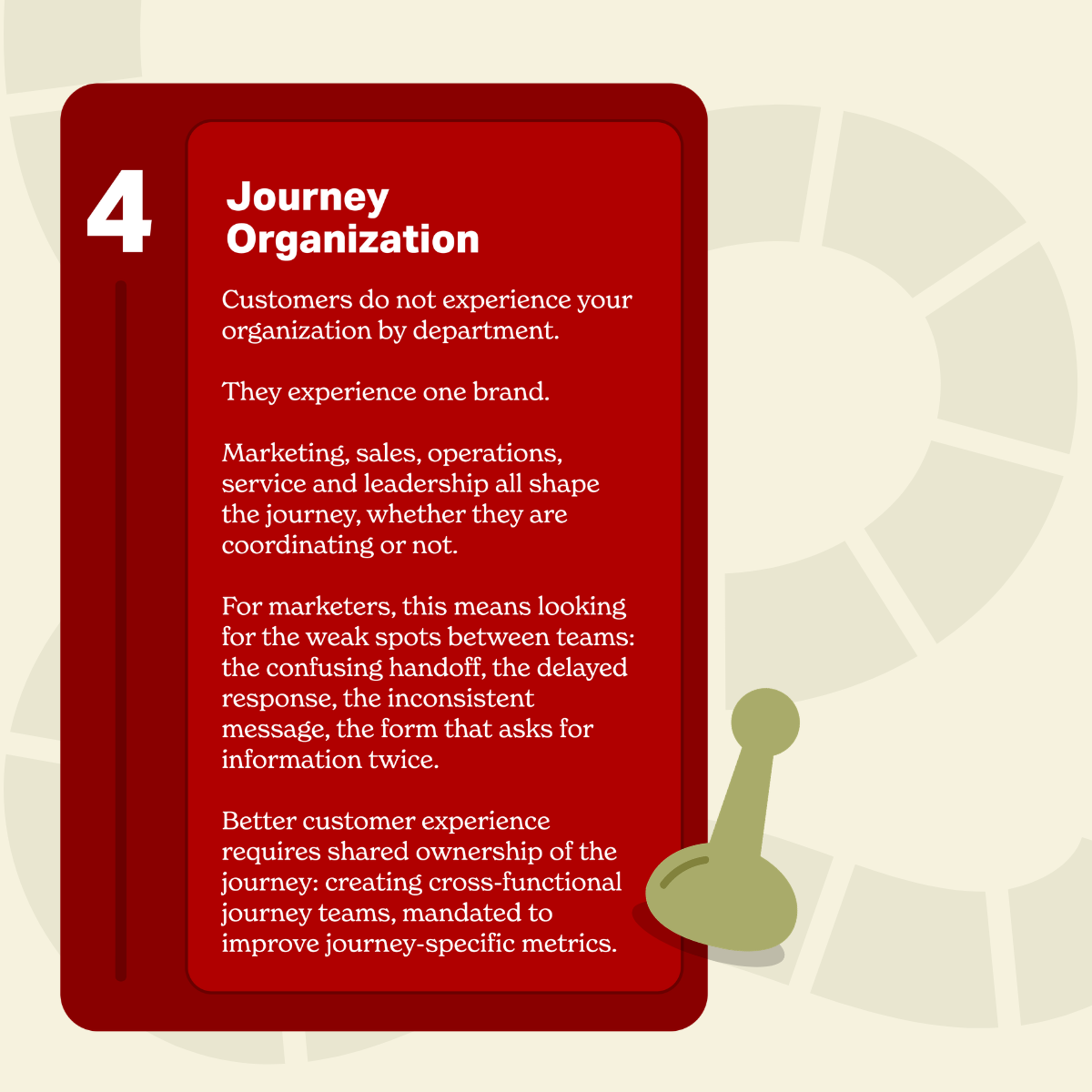
The fourth takeaway is that customer experience has to be organized across the journey. Customers do not experience marketing, sales, operations and service as separate functions. They experience one brand. That makes the handoffs between teams especially important. Where does the message change? Where does the process slow down? Where does the customer have to repeat themselves? Where does the experience stop feeling connected? Better customer experience requires shared ownership, not just better performance within one department.
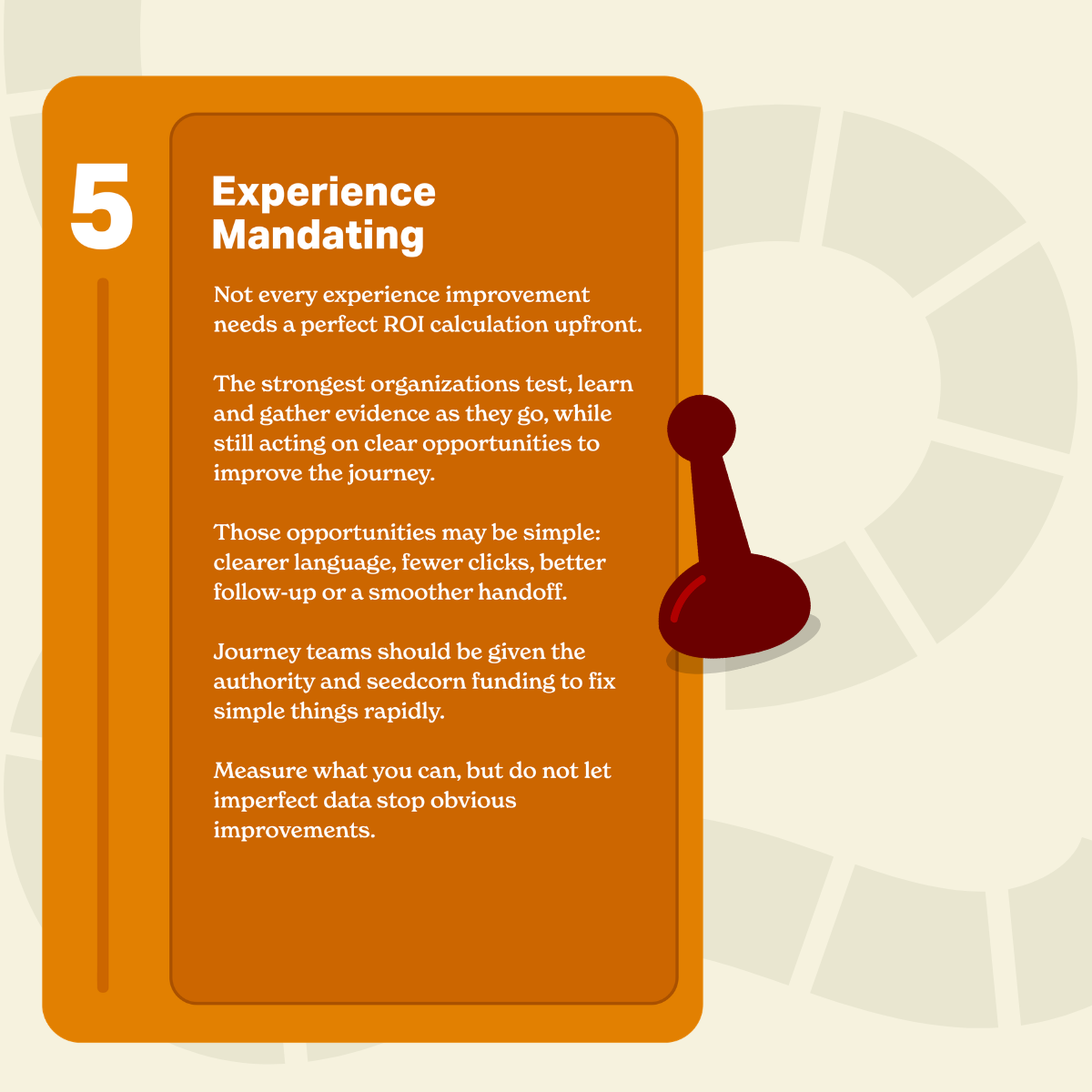
The fifth takeaway is to keep learning while improving. The research does not suggest ignoring measurement. It shows that organizations with a strong customer experience orientation are willing to test and make improvements before every financial outcome is fully proven, while still gathering evidence over time. For marketers, this is a useful reminder: measure what you can, but do not let imperfect data stop obvious improvements to the journey.
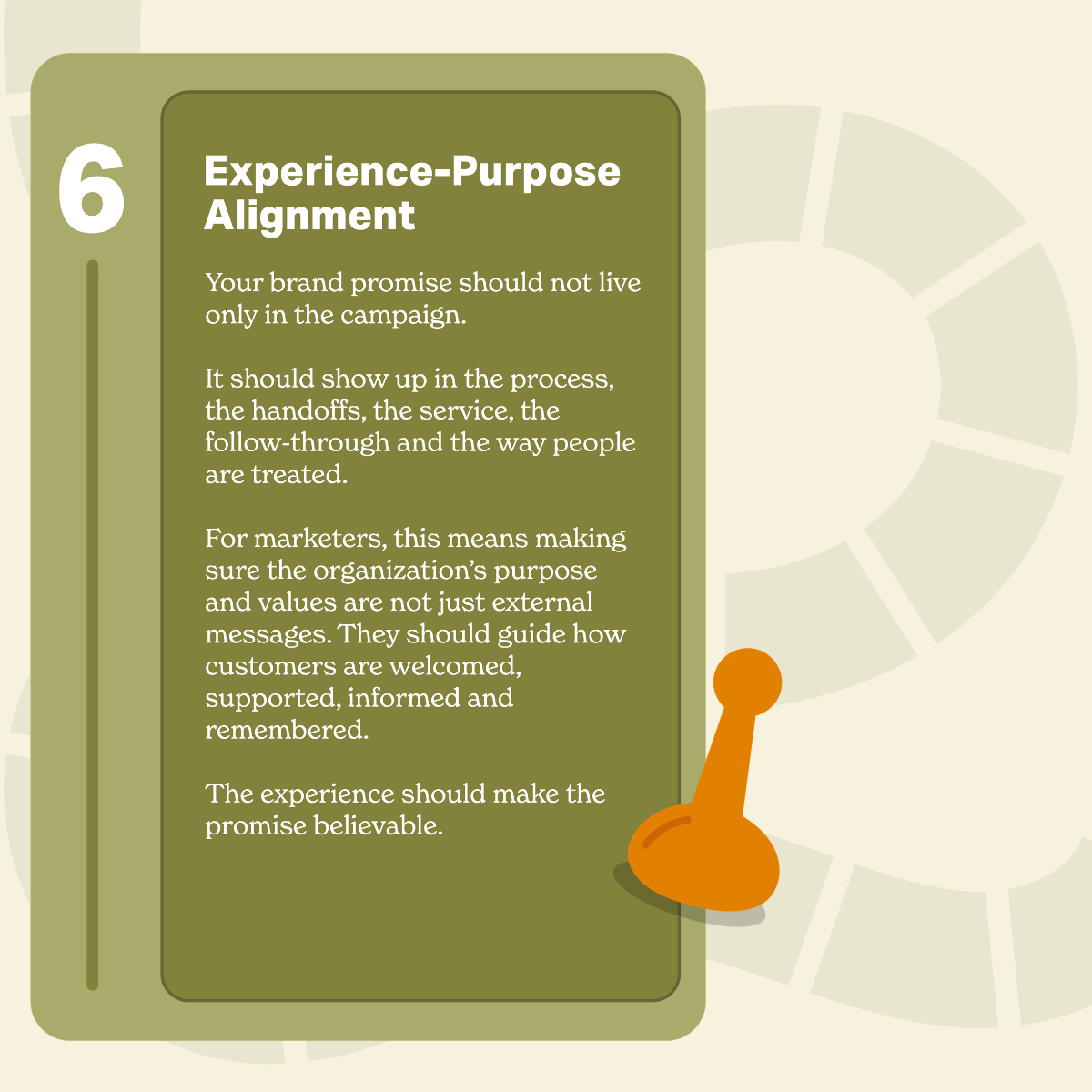
Finally, the experience has to align with the organization’s purpose. A brand promise is only believable when the journey supports it. Purpose and values should not live only in the campaign, the messaging platform or the About page. They should guide how customers are welcomed, informed, supported and remembered.
Taken together, the research shows that customer experience is bigger than communication. It is an organizational learning system: how well a company listens to customers, shares what it learns, acts on that insight and builds better ways of working around the journey.
For marketers, that creates an important role. Marketing does not have to own every touchpoint, but it can help the organization see the journey more clearly and connect the brand promise to the way customers are actually treated.
The strongest customer experiences are built when the whole organization can see the board: what customers need, where they get stuck and how each team can help move the journey forward.
About the Research
Customer Experience Orientation: Conceptual Model, Propositions, and Research Directions
Academy of Marketing Science Review (AMSR); Volume 52 (2024)
Authors:
Citation:
Arkadan, F., Macdonald, E.K. & Wilson, H.N. Customer experience orientation: Conceptual model, propositions, and research directions. J. of the Acad. Mark. Sci. 52, 1560–1584 (2024). https://doi.org/10.1007/s11747-024-01031-y
From the Authors
What specific relevant marketing challenge(s) does your article address?
Many firms are adopting customer experience management as a route to differentiation, but what practices firms should adopt in order to excel at customer experience management was yet to be rigorously researched. Through nine case studies involving 44 interviews, observations and documentary sources, we addressed the following managerial challenges: 1. What does great customer experience management look like? 2. What values and behaviors do leaders need to instil across the whole organization? We then validated and refined our findings through 11 workshops involving 169 managers.
What companies/organizations/industries will benefit from your findings?
We studied organizations across a range of sectors including department stores, supermarkets, luxury fashion retailers, airlines, coffee stores, entertainment venues, insurance and business banking who were all striving to bring a more customer-centric culture across their organizations. Organizations in each of those sectors would benefit from our findings, along with any other sectors (business-to-consumer as well as business-to-business) where the customer experience is important in differentiating the firm.
How and to what extent it may the research benefit those organizations.
Customer experience management is not simply a department or a program. It is a philosophy for what will make the organization effective. To embed this philosophy, we found that firms need to adopt six key practices, which together constitute a “customer experience orientation”. The first three practices are part of an organizational learning process comprising: 1. Journey motivation; 2. Continual experience optimization; and 3. Experience empowerment. The second set of practices relate to institutionalization of learning and comprise: 1. Journey organization; 2. Experience mandating; and 3. Experience-purpose alignment. For details, please see Table 3 of our paper, that lists the value behind each practice, along with three or four behaviours that live this value.
Our main findings section, ‘Customer experience orientation’, works through these six practices, and is full of practical examples to bring them to life. An airline, for example, was seeking to differentiate its tour business in a price-sensitive market. The CEO declared a mission to refocus around the customer. The company began by exploring customers’ existing journeys through immersive research, which revealed opportunities to improve customer journeys that had previously gone unnoticed. The team identified five distinct customer segments, each with very different journey goals. Based on these insights, the company developed a new experience-centric vision which informed everything they did—from how people were treated at the airport, to the in-flight experience, and onward to the destination. Team members from service operations, product development, and marketing worked alongside frontline employees from partner organizations, such as hotels and excursion providers, who were closest to customers at key points in their journeys. The firm also developed a brand community of 1,700 customers to support its efforts. The chief executive reported that the company was able to achieve a financial turnaround as a result of tailoring vacation journeys to different customer goals. The airline improved customer satisfaction and achieved a 30% increase in bookings within a year. This story illustrates several of our practices: for example, journey motivation (focusing the firm around customer journeys), customer experience optimisation (design processes around those journeys), journey organisation (having teams around each journey to take responsibility for continual improvement), and experience mandating (giving permission to employees at all levels to put the experience first and do what it takes to get that right).
What outcomes would be expected?
CXO is a philosophy for what will make the organization effective. The study provides a framework for the impact of CXO on customers’ experience appraisal and hence firm financial performance. A customer experience is appraised based on touchpoint quality, the perceived consistency and seamlessness of a journey as well as the extent to which a journey facilitates the achievement of the customers’ goals. Each of these is improved by the six practices we outline.
The outcome is therefore a superior customer experience and hence enhanced financial performance through enhanced willingness to pay, increased retention, and reduced acquisition costs.
Any other advice for practitioners following directly from the results?
Organize around goal-based journeys: Many firms begin their experience-management efforts with a central experience team, which tends to start by collecting better experience insight. However, such teams can become isolated (as we saw initially in Finch Financial). Cross-functional journey teams that champion the improvement of key customer journeys are important to ensure that experience insight is turned into action. A common mistake is to define teams around the firm’s own processes and products, leading to frustrating inconsistencies in journeys from the customers’ perspective. By defining both journey and team around customer goals, more innovative journey designs can ensue, as we saw in Cygnet Bank and Kite Tours.
Disseminate insight empathically: A related challenge is to ensure that experience insight reaches beyond the pages of research reports to all staff with a role in experience design. A plan is needed to immerse journey teams and the relevant functional and general managers in experience insight. Like the structural challenge identified above, this challenge benefits from executive sponsorship, as it requires resources as well as attention. A noteworthy approach is to involve executives in the insight generation itself.
Treat journeys as always in beta: Journey design is a journey, not a destination. Firms with relatively stable product sets and traditional stage-gate product development processes may be tempted to approach experience design in the same manner. But in markets facing disruption, experience design tends to require rapid innovation loops, which in turn need skills in empathic and agile design. One way to acquire these skills is through partnering with agencies, as we saw with Kite Tours. Another way is to borrow skills from other functions, such as software development.
Enabling such rapid innovation requires attention to funding. Journey teams benefit from having authority and seed-corn finance to conduct low-cost innovation loops simply. But to check that these are heading in an effective direction, long-term modelling of the financial impact of experience appraisal is helpful (as we saw with BaristaBros and Finch Financial).
Empower guided improvisation: Another challenge for some firms’ cultures is to give agency to employees at all levels so that standardized processes can be adapted to idiosyncratic customers. Managers may fear that the resulting benefit of flexibility will come at the cost of brand inconsistency. The field insight that squares this circle is to guide employees’ improvisation at the customer interface through a customer-focused purpose statement and accompanying brand values that align with customers’ experience goals, as was seen at Cygnet Bank. With such guidance in place, overall improvements in customer experience appear to be higher than they are for firms (e.g., ZTel) that lack this ‘purpose-trumps-process’ principle of constrained delegation.
Weave cost control into experience improvement: A common debate within organizations is the extent to which experience improvements can be afforded, on the implicit assumption that superior experience is costly. While some experience enhancements undeniably add to costs, a striking feature of mature experience management is that cost control is tautly woven into experience-management practices. We have noted three actionable examples. First, cost can be incorporated in experience-design exercises as a constraint. Simplifying journey steps, for example, can be more efficient for the firm as well as helpful to the customer. Second, empowerment of front-line staff can be constrained financially. Third, an experience-centric purpose statement can be complemented by a cost-oriented value such as efficiency. Managers may wish to adopt one or more of these ideas.
Extol and model journey-focused behaviors: The role of leaders in embedding CXO is not restricted to the institution of formal structures and processes. Leaders also play a part in inculcating experienced-focused purpose and value statements through explicit exhortations of their importance. We saw this in senior management events hosted by the CEOs of Vibrant and Kite Tours. The efficacy of this is plausible in the light of research on the cultural impact of purpose and value statements in steering employee motivations and behavior (Beer et al. 2021). In addition, leaders can model behavioral norms, particularly those involving fluid working across internal and external organizational boundaries (e.g., journey immersing, self-appointing, and celebrating). These norms prioritize the customer’s journey even when it requires cross-organizational action. Importantly, our case data contain successful examples of these leadership behaviors not just from the board level but also from middle management, such as Finch Financial’s insight manager and Cygnet Bank’s experience manager.
Assess and develop the maturity of customer experience orientation: Finally, our findings create a managerial opportunity to assess a firm’s current approach to experience management. The value typology in Table 3 of our paper can be presented to managers, from which they can assess the extent to which each value and behavioral norm is present. This may be useful in identifying directions for enhancement in experience management practice.