Human + AI: How Creative Collaboration Can Change Customer Perceptions
Artificial intelligence is becoming an increasingly common part of creative work. From advertising and graphic design to interior design and personalized shopping experiences, businesses are using AI-powered tools to generate ideas, explore possibilities and help deliver services.
But while companies may see opportunities to improve efficiency and expand their creative capabilities, customers don't necessarily view AI the same way.
Many customers recognize AI's ability to analyze information and perform technical tasks, but remain skeptical of its ability to produce genuinely creative work. That skepticism can influence how they evaluate products and services developed with AI.
So how can businesses take advantage of AI without diminishing customers' perceptions of creativity?
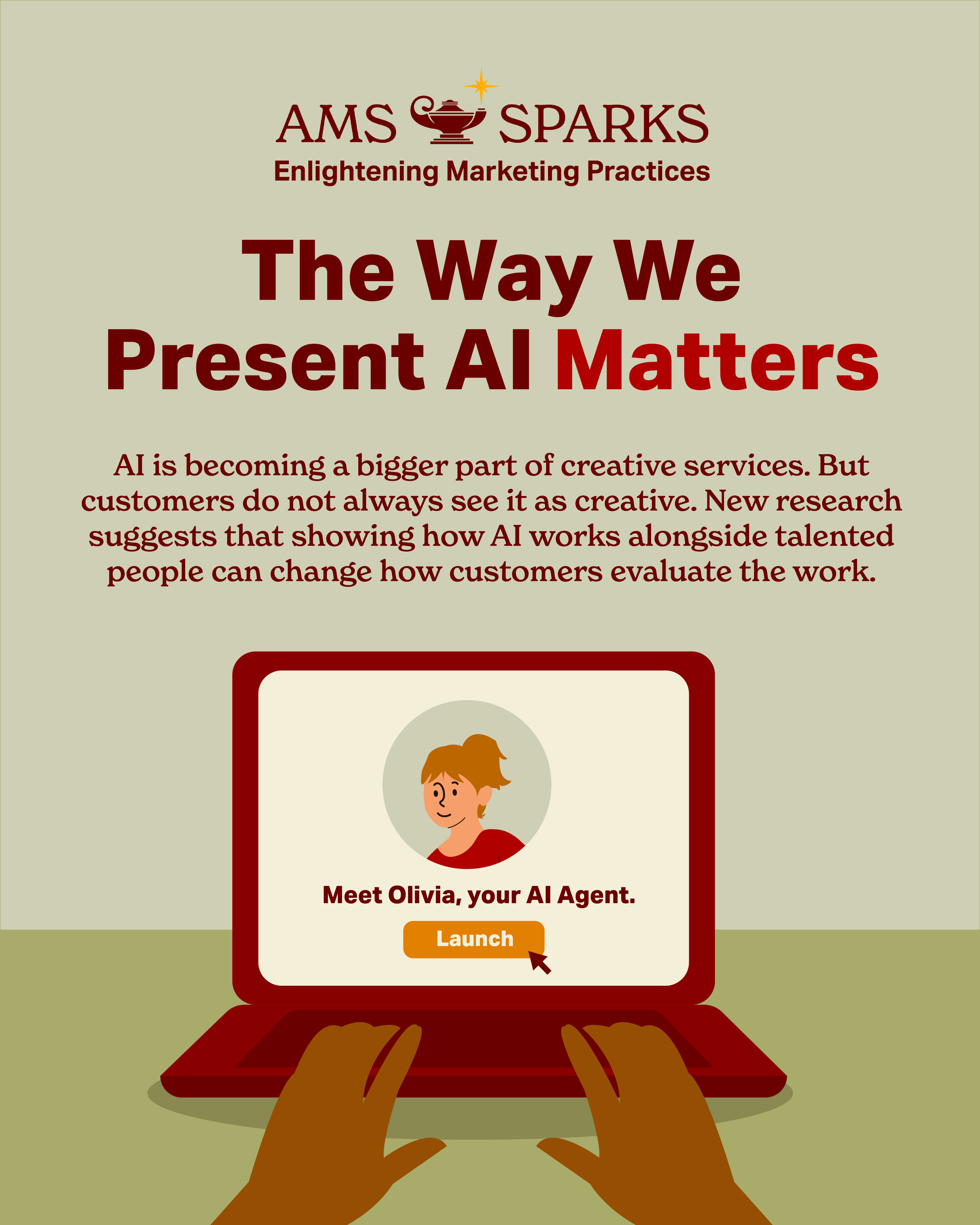
In their article, "Pairing Up with Anthropomorphized Artificial Agents: Leveraging Employee Creativity in Service Encounters", published in the Journal of the Academy of Marketing Science, researchers Lexie Lan Huang, Rocky Peng Chen and Kimmy Wa Chan examine whether presenting AI as a humanlike collaborator can improve how customers evaluate creative services.
Their findings suggest that the answer depends on more than simply using AI or giving it human characteristics. What matters is whether customers see AI and human employees as a cohesive creative team.
Why Customers May Undervalue AI Creativity
AI can assist with everything from developing visual concepts to creating personalized product recommendations. Yet customers often perceive artificial agents (AAs), including virtual assistants and physical robots, as less creative than people.
The researchers confirmed this skepticism in an initial pilot study. When asked to evaluate creativity on a seven-point scale, participants rated artificial agents at an average of 3.94, compared with 5.24 for an average person.
That difference presents a challenge for companies using AI in creative services. Even when AI contributes to a product or service, customers' preconceived ideas about the technology can affect how they judge the final result.
The researchers investigated whether those perceptions could change when an artificial agent was presented as more humanlike and paired with a creative professional.
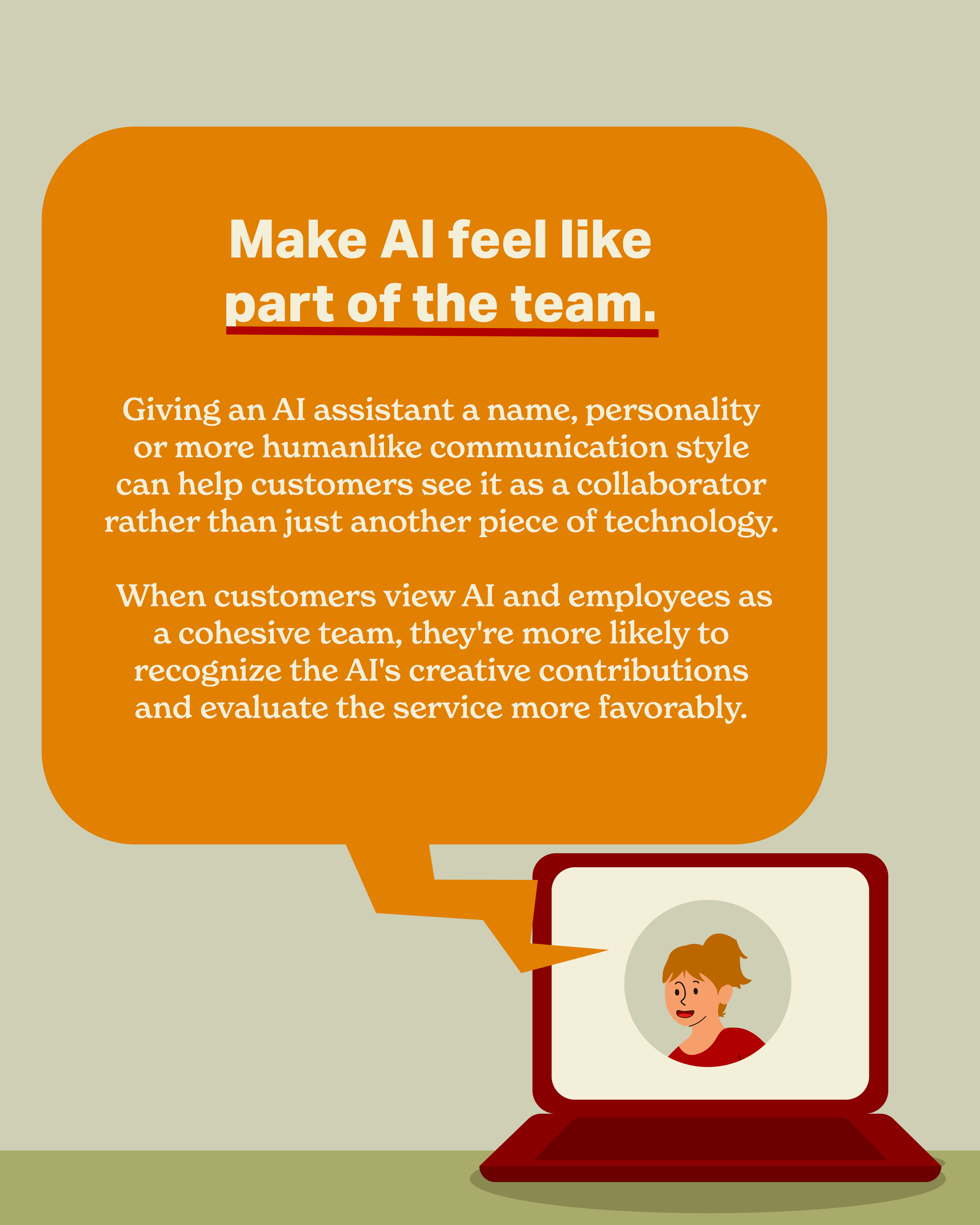
Known as anthropomorphism, this approach involves giving a nonhuman entity recognizable human characteristics, such as a name, personality, facial features or conversational communication style.
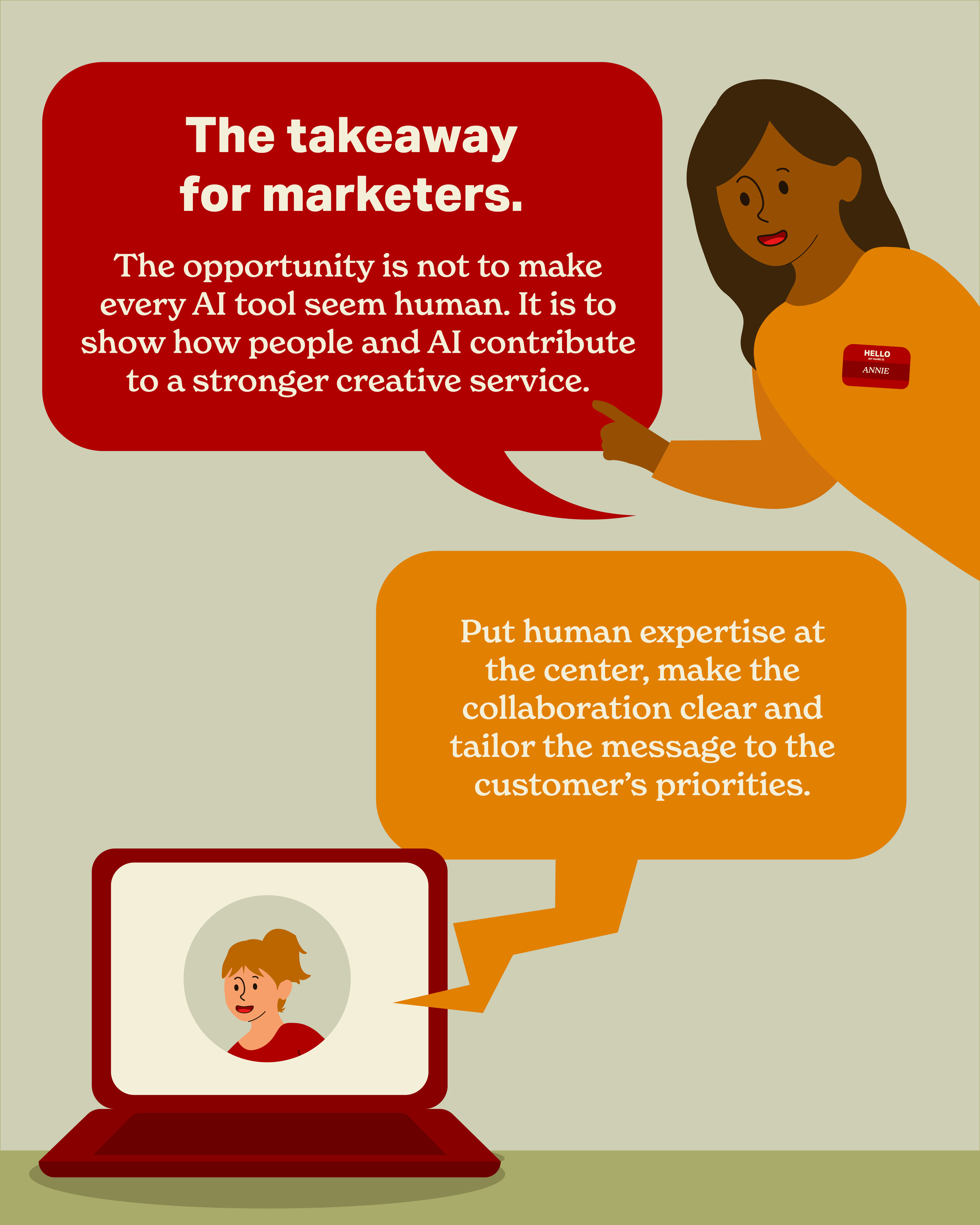
But the research uncovered an important distinction: Making AI more humanlike on its own was not enough to significantly improve perceptions of its creativity. The benefits emerged when the humanlike agent was presented as collaborating with a creative employee.
The Connection Between Human Expertise and Perceived AI Creativity
At the center of the research is a psychological phenomenon called trait transference.
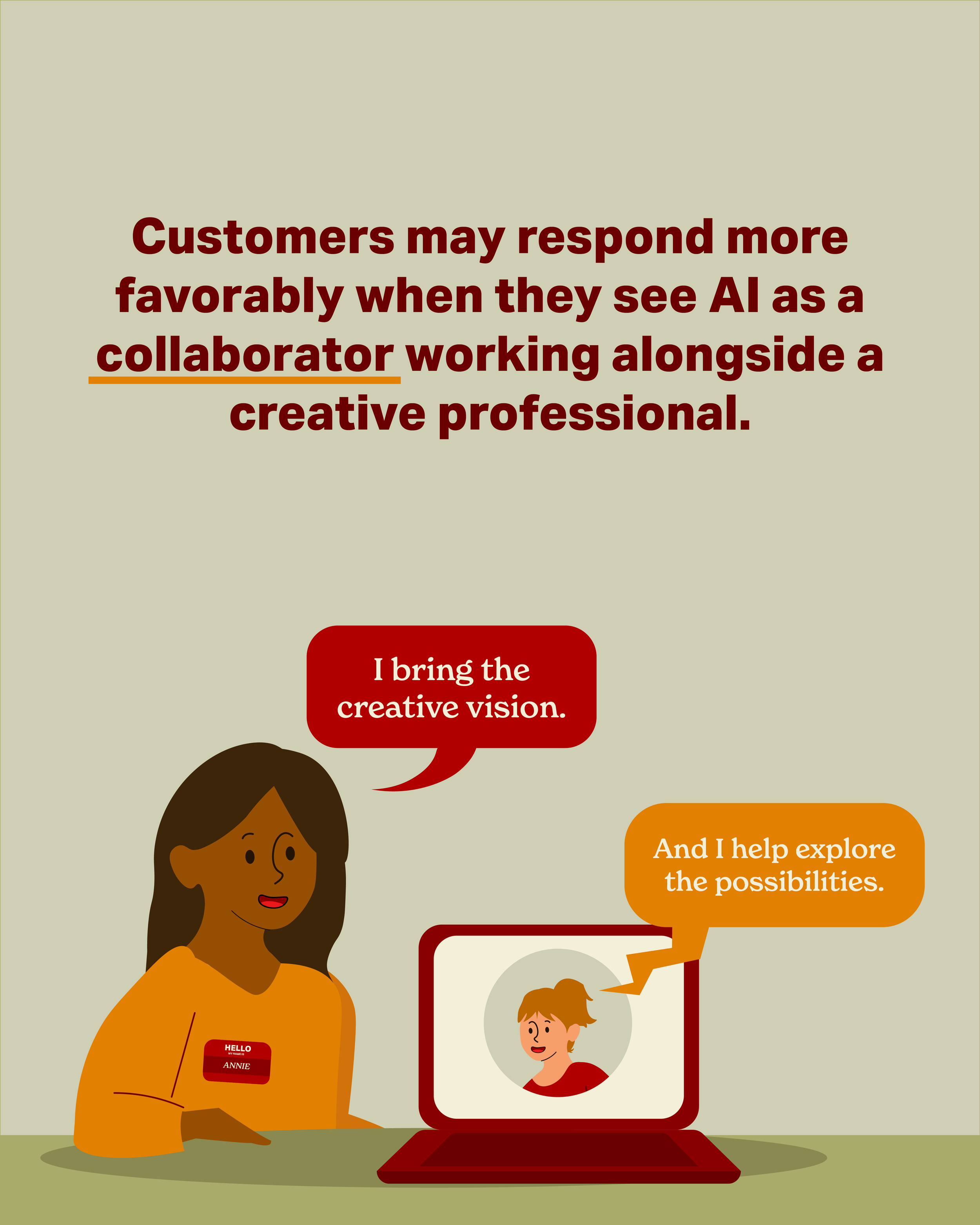
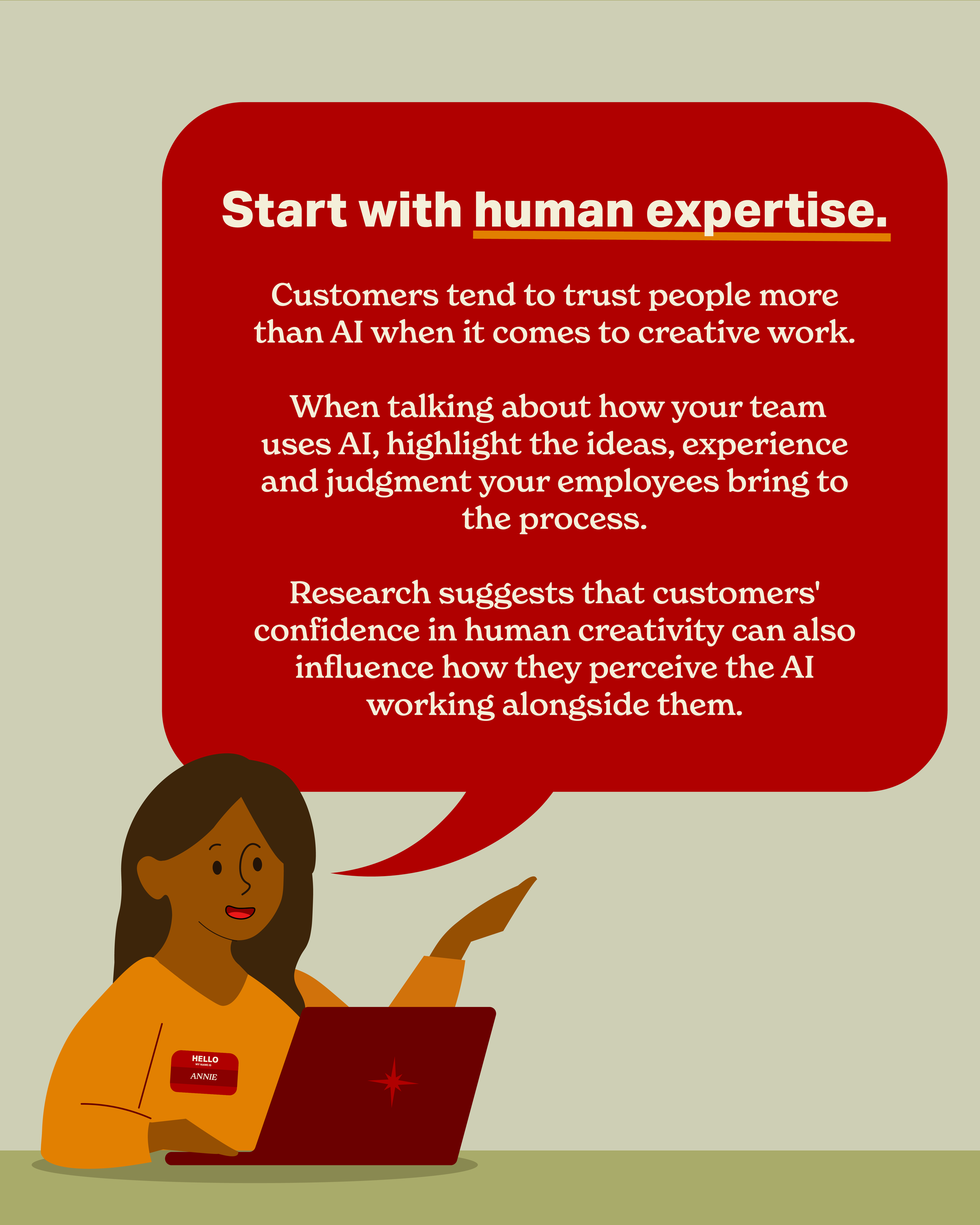
When people view individuals as members of a cohesive group, they may associate the qualities of one member with others in that group. In a creative service setting, customers who recognize an employee as talented and imaginative may extend those perceptions to an AI agent they believe is working closely with that employee.
The researchers found that this process depended on customers perceiving the human and AI as a unified team, a concept known as entitativity.
For example, consider a design service that introduces customers to an experienced designer and an AI assistant. If the AI is presented as an impersonal software program, customers may view its contributions separately from the designer's creativity.
But if the AI has a recognizable identity and is presented as an active member of the design team, customers are more likely to associate the designer's creative abilities with the AI.
As a result, they may evaluate the team's creative output more favorably.
This is particularly relevant for marketing managers because it suggests that customer perceptions are influenced not only by the final product but also by how the people and technology behind that product are presented.
What the Research Found
The researchers conducted five studies involving participants from China, the United Kingdom and the United States. The experiments examined creative services and products, including furniture design, interior design, household products and paintings.
Across the studies, customers generally responded more favorably when creative employees were paired with anthropomorphized artificial agents rather than agents presented as impersonal technology.
The research measured several outcomes, including perceptions of creativity, product evaluations, purchase intentions, willingness to pay, word-of-mouth intentions and actual purchasing behavior.
One field experiment involving 116 online-store customers found that participants who encountered a humanlike AI–designer team spent an average of $12.99 during the following month, compared with $7.33 among customers who encountered a designer working with an impersonal AI program.
Customers were also more likely to express that they liked the product designed by the humanlike AI team: 86.4% compared with 70.2%.
Another experiment involving 312 participants compared furniture designs attributed to four different arrangements: a human designer working alone, two human designers working together, a designer paired with impersonal AI, and a designer paired with humanlike AI.
Participants evaluated the designs from the humanlike AI–designer team more favorably than those from the solo designer or the impersonal AI–designer team. Importantly, evaluations of the humanlike AI–designer team were not significantly different from those of the two-person human team.
These findings suggest that businesses may be able to benefit from the efficiencies of AI-assisted services while maintaining favorable customer perceptions of their creative work.
However, the research measured customer responses rather than the objective quality of the creative output or the actual cost savings of using AI.
Why the Relationship Matters as Much as the Technology
One of the more interesting findings is that the perceived strength and stability of the human–AI relationship matters.
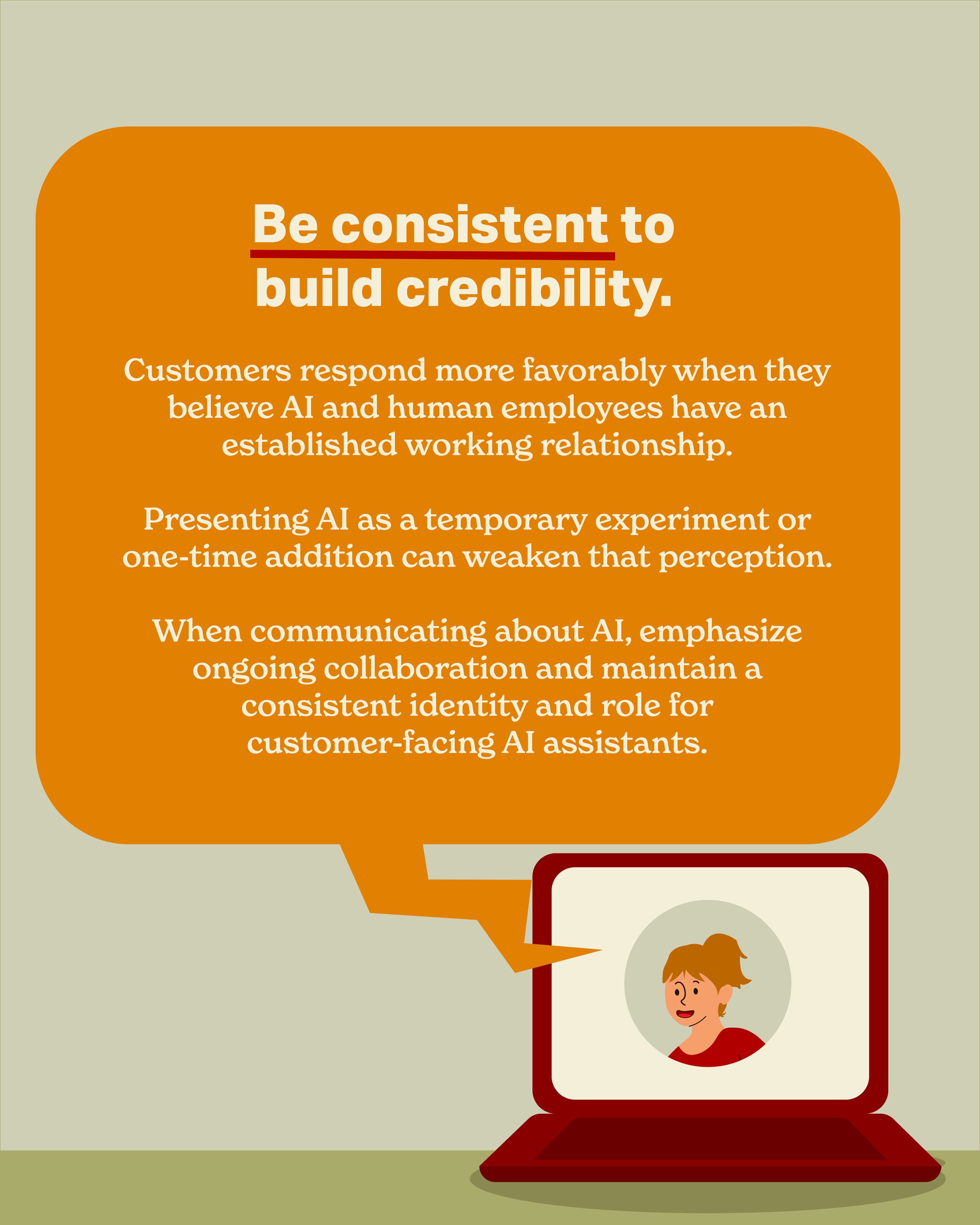
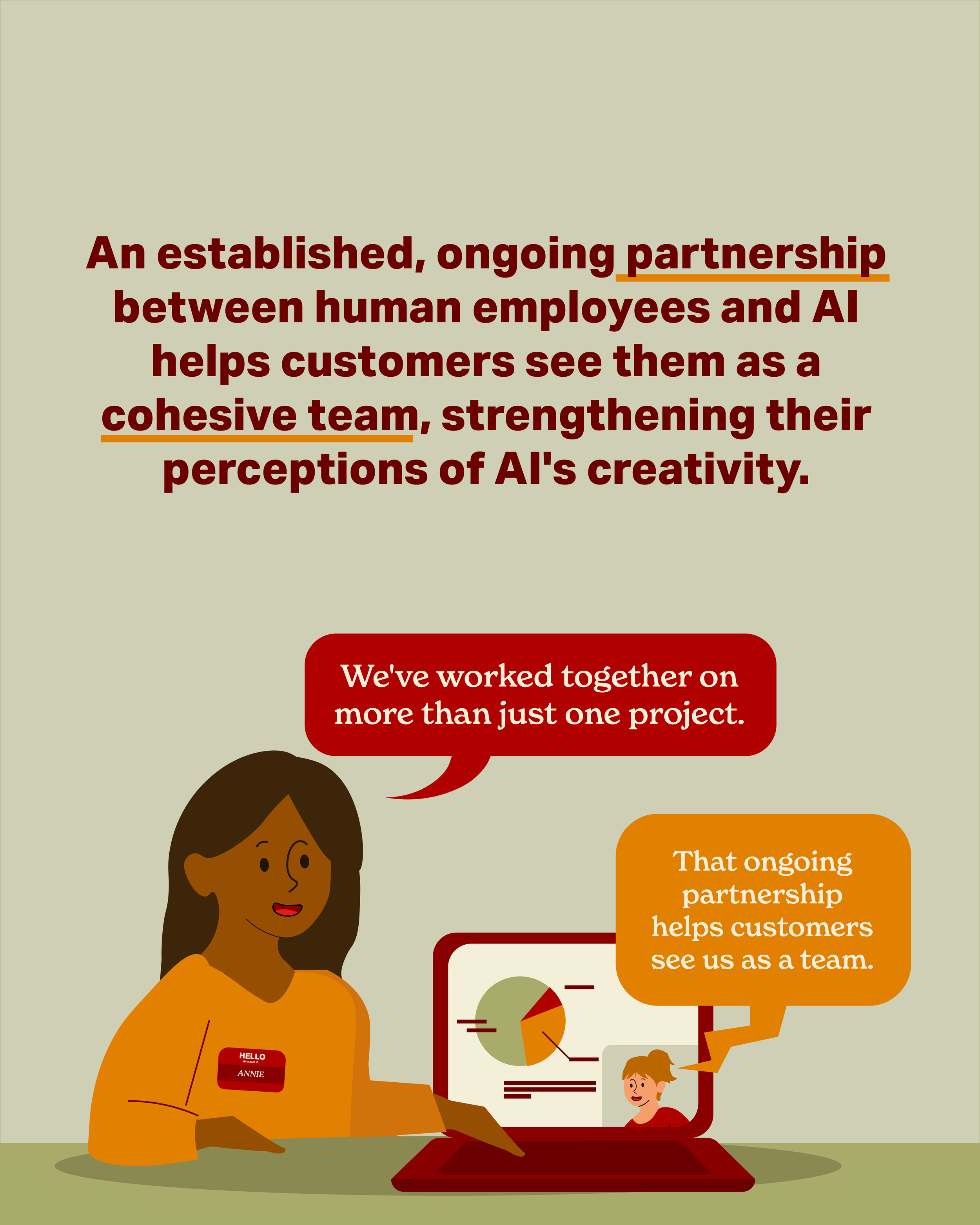
Customers responded more favorably when they believed the employee and artificial agent had an established history of working together and would continue collaborating.
When the partnership appeared temporary or limited to a single project, the positive effects of anthropomorphism were weakened.
For businesses, this presents a different way to think about communicating AI adoption.
Companies often emphasize new technologies as evidence of innovation. But when marketing a creative service, repeatedly focusing on a newly introduced AI tool may not be as effective as demonstrating how that technology has become part of an established creative process.
The researchers suggest reinforcing the relationship through consistent branding, communication and examples of collaborative projects.
In their accompanying responses for AMS Sparks, the authors also emphasize the importance of consistency across the customer experience. An AI assistant's identity, communication style and role should remain recognizable across websites, applications, emails and service interactions.
Employees can play an important role in establishing that relationship, too. How they describe working with AI can influence whether customers perceive the technology as an isolated tool or as part of a coordinated creative team.
Not Every Customer Responds the Same Way
The researchers also examined whether customers' motivations influence how they evaluate human–AI teams.
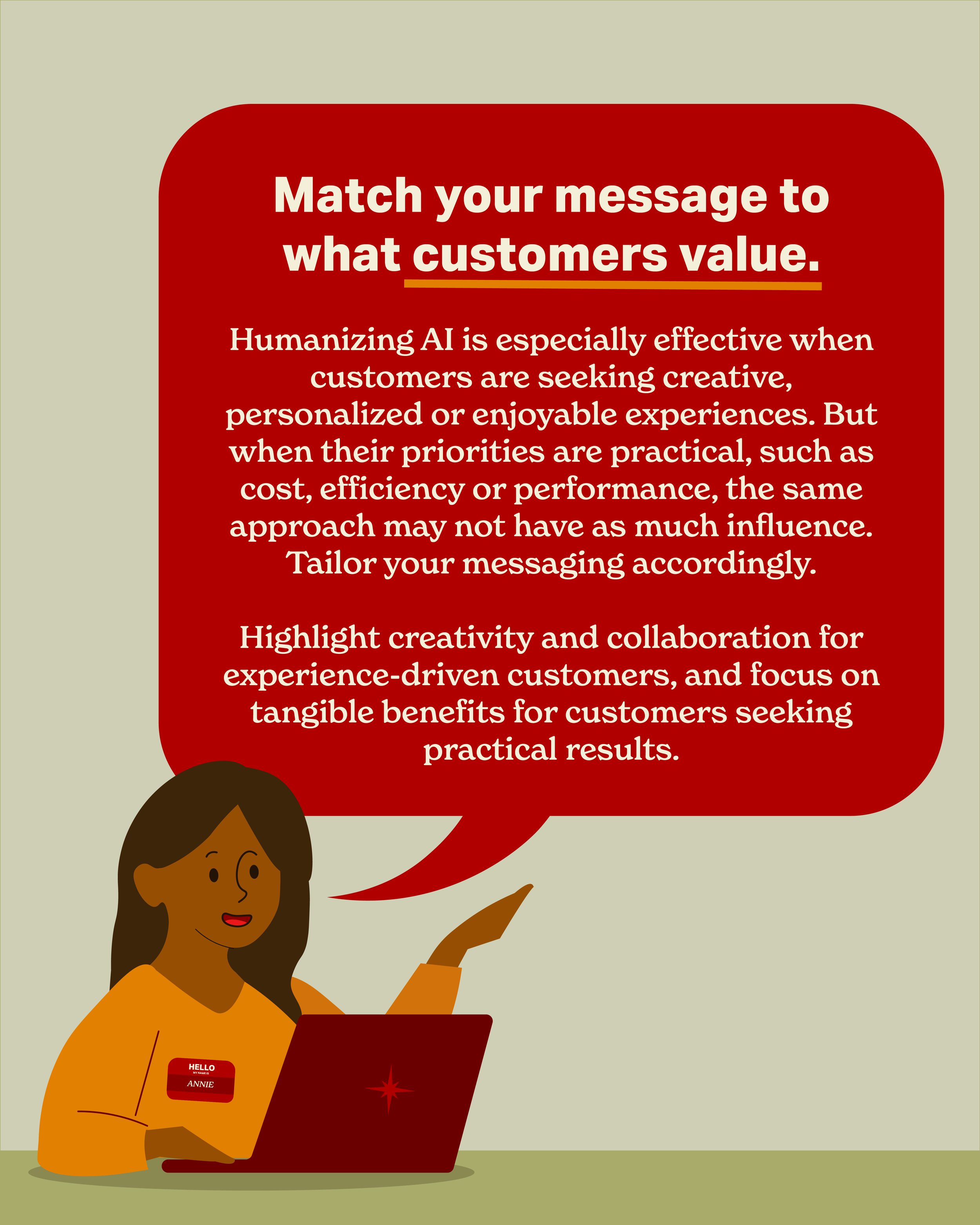
They distinguished between two types of consumption goals: hedonic, which focus on enjoyment, creativity or the experience itself, and utilitarian, which focus on practical needs such as functionality, performance or financial value.
The distinction matters because customers approach these decisions differently.
Consider two people hiring an interior designer. One wants to create a personalized living space that reflects their tastes and makes their home more enjoyable. The other is renovating an investment property and prioritizes cost, functionality and resale value.
Although both customers are purchasing interior design services, their motivations are different.
The researchers found that humanizing AI improved product evaluations and purchase intentions among customers with hedonic goals. Among customers focused on utilitarian goals, the same effect was not statistically significant.
For marketing managers, the implication is that the appeal of human–AI collaboration may depend on what customers are trying to accomplish.
When customers are seeking a creative or personalized experience, communicating the collaborative relationship may contribute to more favorable evaluations. When customers are primarily concerned with practical outcomes, information about performance, reliability or value may be more relevant.
The researchers also found that customers' existing beliefs about how closely group members resemble one another influenced whether they transferred perceptions of creativity from employees to AI.
Taken together, these findings reinforce the importance of understanding customer motivations and perceptions rather than assuming one approach to AI messaging will work equally well for every audience.
What This Means for Marketing Professionals
The findings offer a useful perspective for companies integrating AI into customer-facing creative services.
For advertising agencies, design firms, styling services and similar businesses, the opportunity extends beyond adopting technology to improve internal processes. It also involves helping customers understand the role AI plays in the service they are purchasing.
A creative agency, for example, might use AI to explore visual concepts, develop preliminary ideas or evaluate alternative approaches. The agency's designers and creative directors still bring the experience, judgment and understanding of the client's needs that guide the work.
Communicating that relationship can help establish the credibility of the creative process while demonstrating how AI contributes to it.
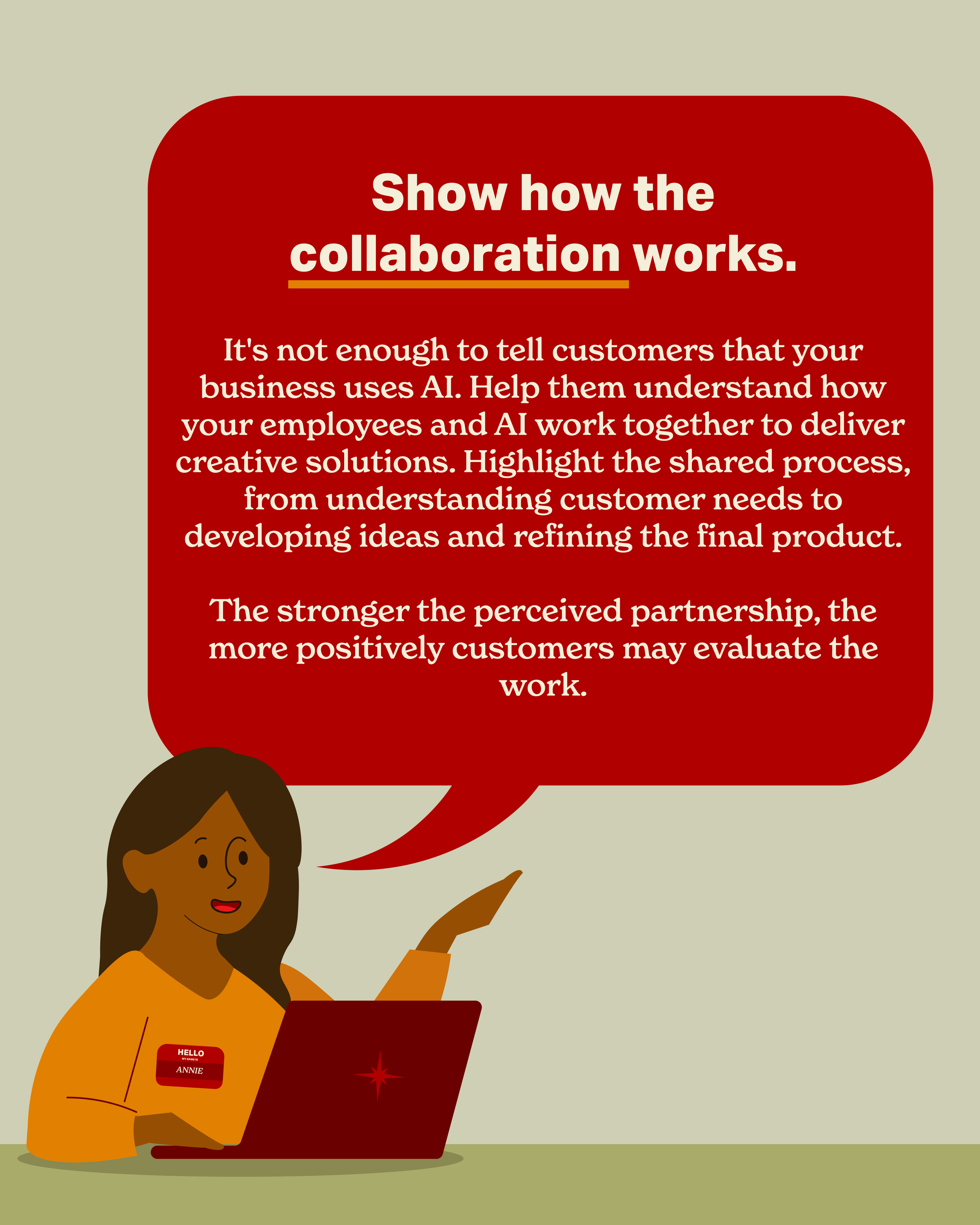
Businesses can also make collaboration more visible through case studies, project examples and explanations of their workflows. Rather than simply stating that a service is AI-powered, they can demonstrate how employees and technology contribute to the finished work.
There are still important questions to explore. The studies focused on creativity in two-member human–AI teams, leaving opportunities to examine how customers respond to larger teams, multiple AI agents and other qualities beyond creativity.
For now, the findings offer a clear insight: How customers perceive the relationship between people and AI can influence how they value the creative work that relationship produces.
About the Research
Pairing Up With Anthropomorphized Artificial Agents: Leveraging Employee Creativity in Service Encounters
Journal of the Academy of Marketing Science (JAMS); Volume 52 (2024)
Authors:
Citation:
Huang, L.L., Chen, R.P. & Chan, K.W. Pairing up with anthropomorphized artificial agents: Leveraging employee creativity in service encounters. J. of the Acad. Mark. Sci. 52, 955–975 (2024). https://doi.org/10.1007/s11747-024-01017-w
From the Authors
What specific relevant marketing challenge(s) does your article address?
More and more artificial agents (AAs)—such as virtual assistants and physical robots—are adopted in creative industries, working alongside human employees on design-oriented services (e.g., interior design and painting). Yet customers often view AAs as capable at objective, quantifiable tasks but not well-equipped for tasks that require creativity, which leads them to discount the service outputs and evaluate the service less favorably. This posts a marketing challenge that customers are skeptical about AA creativity when AAs are deployed as part of a design service team with human employees. We respond to these concerns to examine whether anthropomorphizing the AA (making it more human-like) can lead to better evaluation of the AA’s creativity and the service output.
Provide precise examples of companies/organizations/industries that will benefit from your findings?
Companies and industries that are in creative domains and already using or considering artificial agents (AAs) that collaborate with human employees will benefit most from our findings. Below are examples of industries and companies:
(1) Interior Design and Architecture Firms: Companies like Havenly, Modsy, and Laurel & Wolf that pair human interior designers with AI design tools to generate floor plans, color palettes, and furniture recommendations.
(2) Fashion and Styling Services: Companies such as Stitch Fix pairs human stylists with AI algorithms that analyze customer preferences, body type, and fashion trends to curate personalized clothing selections.
(3) Art Galleries and Artist Studios: Contemporary art spaces featuring works co-created by human artists and AI systems (like the robot artist Ai-DA or human-AI collaborations in generative art).
(4) Advertising and Creative Agencies: Marketing agencies such as FOUR Agency and Jellyfish that heavily deploy AA alongside creative directors and designers to generate ad copy, visual concepts, and campaign ideas.
Using one of the entities listed above, illustrate how and to what extent it may benefit.
Using Stitch Fix (human stylists collaborating with AAs) as an example, the firm may worries that customers will view AA as rigid and incapable of genuine creativity, thereby devaluing the personalized styling service. Our results show that this skepticism can be overcome if the AA is anthropomorphized (e.g., given a name, persona, and interactive role) and the stylist’s creativity is emphasized simultaneously. In this case, customers are more likely to transfer creativity from the human stylist to the AA teammate, leading them to evaluate the styling service more favorably and show higher purchase intentions. In sum, if Stitch Fix wants to fully leverage AA without sacrificing perceived creativity or risking customers’ negative evaluations, it should frame the AA not as a background tool, but as an active teammate that collaborates with human stylists to deliver superior creative results.
How can the recommendations from your findings be implemented?
Firms can implement our recommendations by designing and communicating the human–AA team so customers are more likely to perceive a cohesive “team.” In practice, this can be achieved through a few concrete steps:
(1) Anthropomorphize the AA in customer-facing communication, such as giving it a human name/persona, human-like visual cues (when applicable), and first-person communication, rather than presenting it as an impersonal “system”.
(2) Increase perceived entitativity of the team, for example by visually and verbally signaling unity (e.g., coordinated branding, explicitly stating shared goals, and showing coordinated collaboration rather than isolated handoffs).
(3) Signal temporal stability by framing the employee-AA collaboration as long-term and ongoing (e.g., referencing a history of working together and avoiding “new pilot tool” framing).
(4) Target the right customers / contexts, by (a) identifying segments more receptive to group-based inference (stronger “birds of a feather” beliefs) and/or (b) shaping the service journey to feel more hedonic/experiential.
What outcomes would be expected?
Based on our findings, firms can expect improved service evaluations (customers rating the service and its creative output more favorably) and better behavioral outcomes (e.g., increased purchase rates, willingness to pay, and word-of-mouth). Specifically, when a creative employee is paired with an anthropomorphized (vs. non-anthropomorphized) AA, customers perceive the AA's creativity more favorably, which boosts overall product evaluations and customer liking. This translates into tangible financial benefits, with customers spending more money when served by the service team. Additionally, firms can achieve these favorable outcomes while enjoying the cost efficiencies of AAs, as results showed that the optimized human-AA team performed as well as an all-human team.