
The DTC Ripple Effect: What Happens to Retail Partners When Brands Go Direct
The DTC Ripple Effect: What Happens to Retail Partners When Brands Go Direct
For many brands, launching a direct-to-consumer (DTC) channel is an attractive way to reach customers, gain first-party data and create another path to purchase.
But going direct also changes the relationship between a brand and the retailers that already sell it. A retailer that was once solely a partner is now also competing with the manufacturer for the same customer.
That raises an important question: How do retailers respond when a brand begins selling directly to consumers?
In the study, “Retailer Marketing Mix Response When Launching a Direct Channel: Not All Retailers Are Alike,” published in the Journal of the Academy of Marketing Science (JAMS), researchers Michiel Van Crombrugge, Els Breugelmans, Kathleen Cleeren and Scott A. Neslin examined what happened after a global consumer electronics manufacturer launched its own online channel.
Their findings point to an important lesson for marketers: A DTC strategy cannot focus only on the consumer. It also needs to account for how retail partners are likely to respond.
Retailers may pull back after a DTC launch
The researchers examined the brand across 19 retailers and 34 product categories, comparing retailer assortment, pricing and sales before and after the DTC launch. One year later, the average retailer:
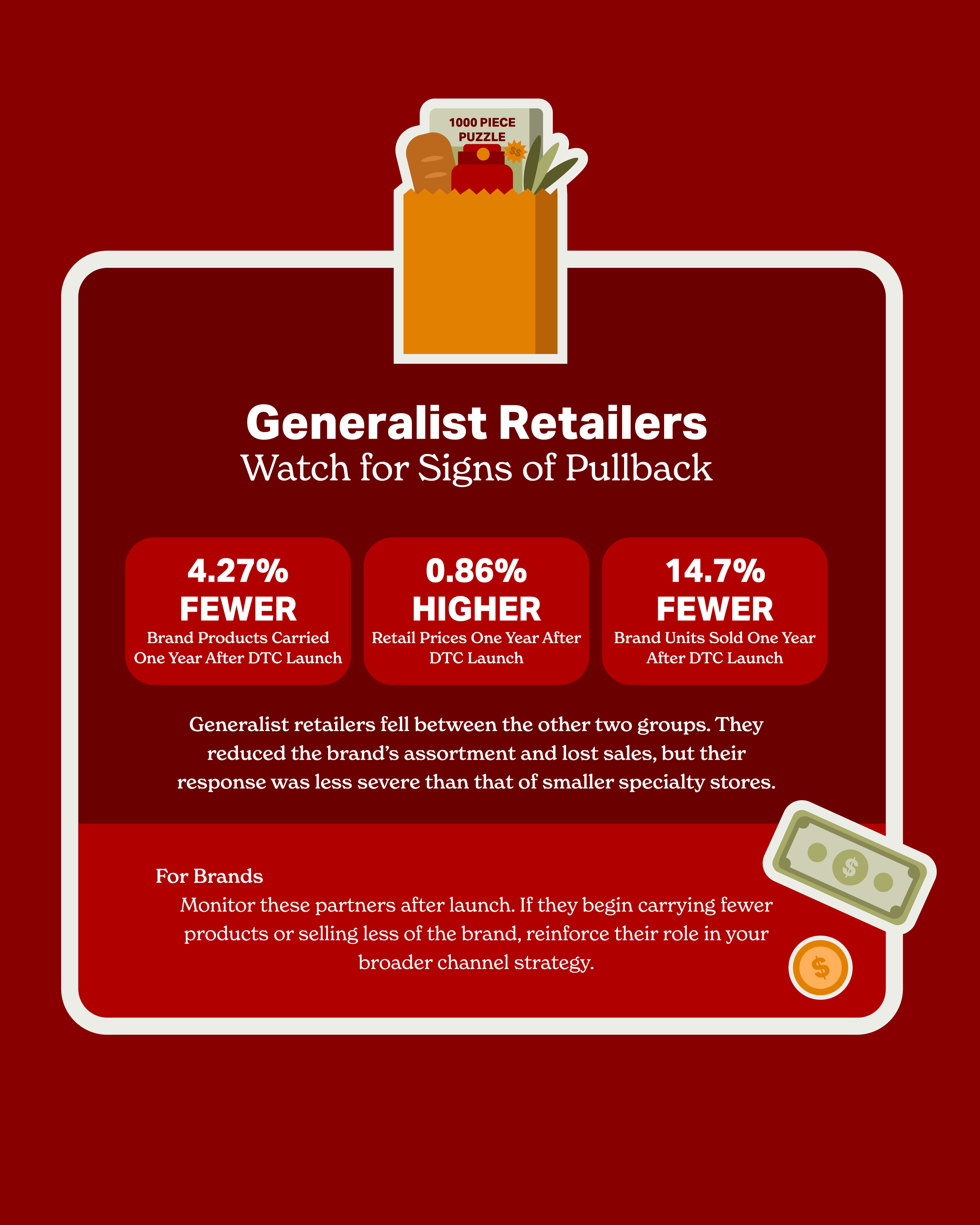
Carried 4.27% fewer of the brand’s products
Increased retail prices by 0.86%
Sold 14.7% fewer units of the brand
Across the 301 retailer-category combinations studied, that translated into a decline of nearly 189,000 units and approximately €10 million in retail revenue.
The takeaway is not that DTC is inherently bad for brands. The study did not have the manufacturer’s direct-channel sales or profitability data, so it could not determine the total financial impact of the launch. What it does show is that retail-channel performance can change when a manufacturer begins competing directly with its partners.
Not every retailer responds the same way
The average results mask significant differences across retailer types.
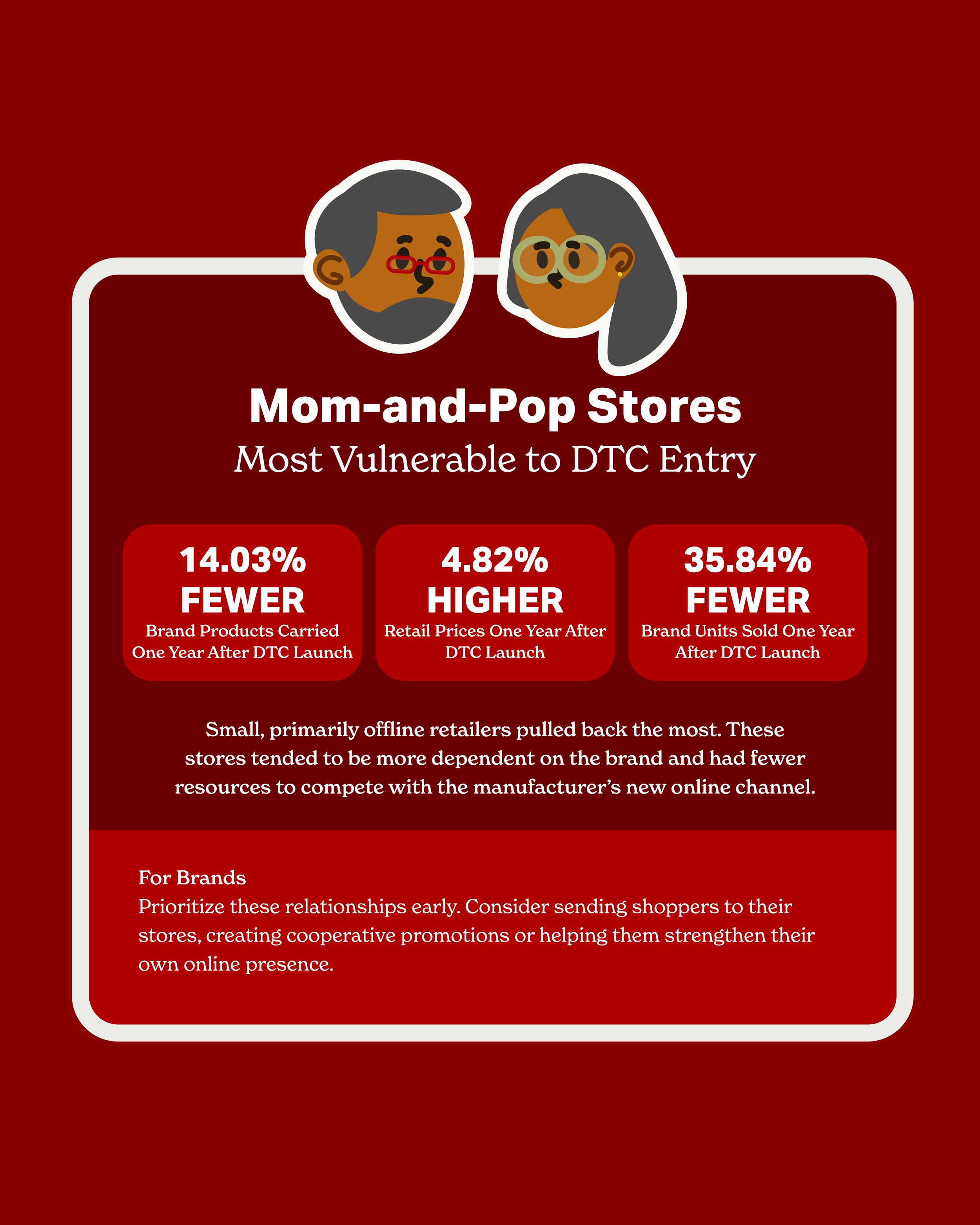
Mom-and-pop electronics stores were the most vulnerable. They carried 14.03% fewer of the brand’s products, increased prices by 4.82% and sold 35.84% fewer units.
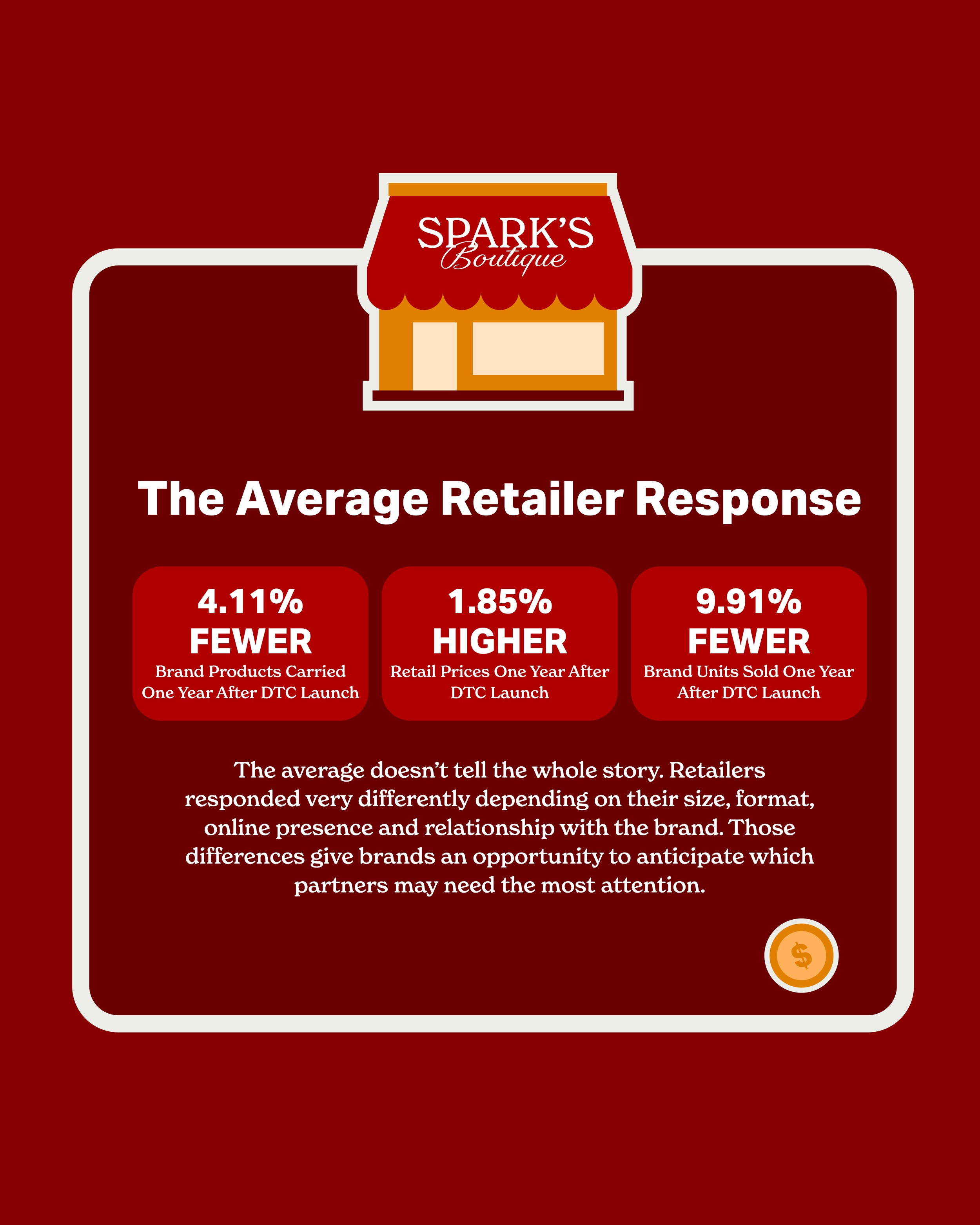
Generalist retailers showed a more moderate response. They carried 4.11% fewer products, raised prices by 1.85% and sold 9.91% fewer units.
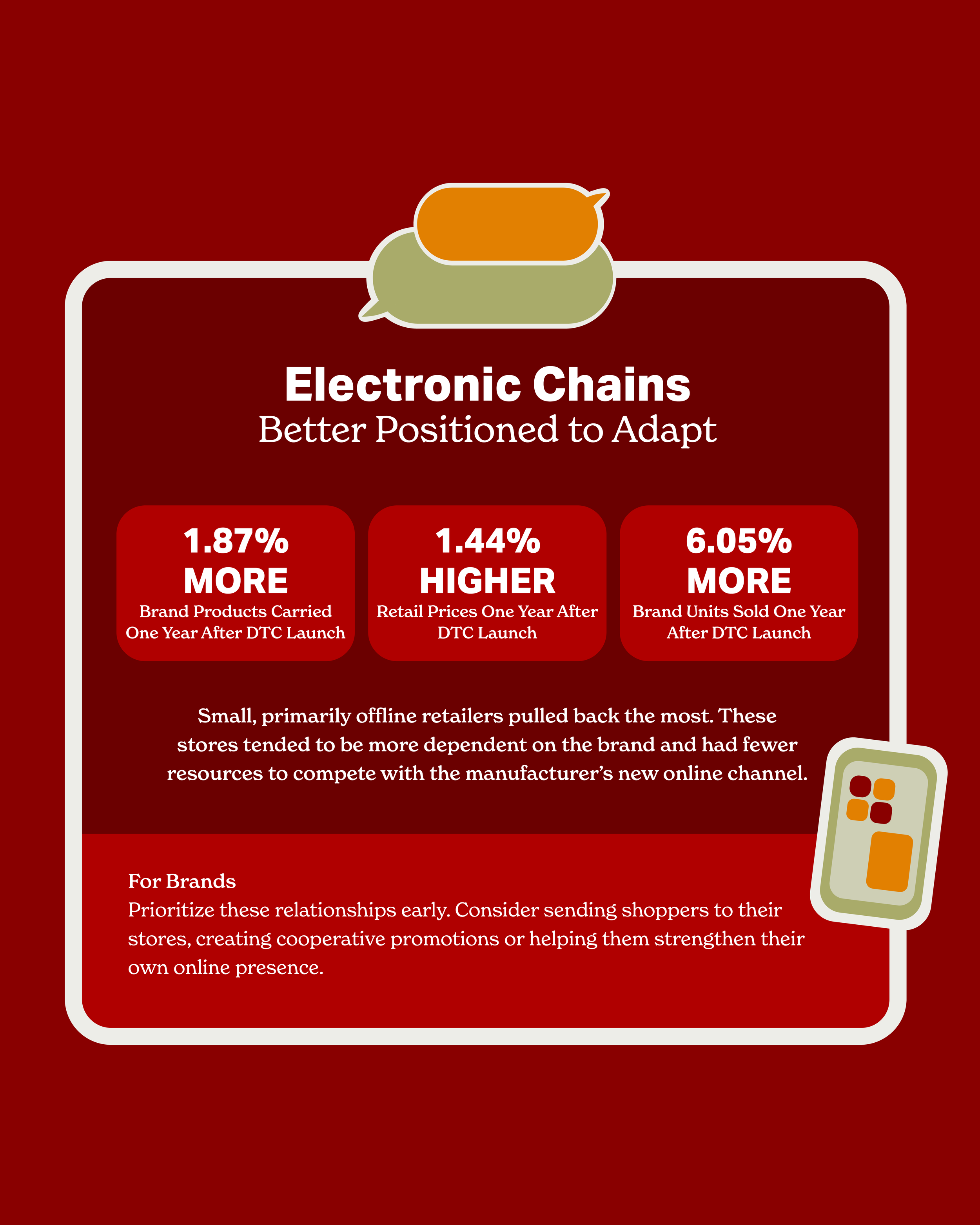
Large multichannel electronics chains moved in the opposite direction. They increased the number of brand products they carried by 1.87% and ultimately sold 6.05% more units.
For practitioners, that difference may be more useful than the overall average. Instead of asking whether retailers will react to a DTC launch, marketers can ask: Which partners are most likely to pull back, and which are better positioned to adapt?
Why does DTC affect retailers differently?
The researchers explain the tension through two competing forces: value creation and value capture.
A manufacturer's DTC channel can create value for retail partners. The brand's website may increase awareness and interest, sending some shoppers to retailers that carry the products. The manufacturer's direct pricing may also give retailers more room to raise their own prices. At the same time, the manufacturer can capture more value for itself. Customers may shift from retailers to the direct channel, and the manufacturer becomes less dependent on retailers to reach the market. How a retailer experiences that tradeoff depends on its own position.
A large multichannel retailer may be well equipped to capture new demand generated by the brand. A smaller, offline retailer that depends heavily on the manufacturer may see the same DTC channel primarily as a competitive threat.
Know which retail partners may need more attention
One of the most actionable findings is that retailer responses were not random. The researchers examined characteristics including retailer size, specialist versus generalist format, online presence, the brand's share of the retailer's sales, pricing and assortment. Those characteristics helped explain differences in how retailers responded. The findings suggest brands should pay particular attention to how these characteristics combine, particularly among retailers that are:
Smaller
Primarily or entirely offline
Highly dependent on the brand
Already carrying a large assortment of the brand
Selling the brand at relatively high prices
These characteristics often came together in the mom-and-pop segment, which experienced the largest decline in brand sales. For brands, that creates an opportunity to identify higher-risk relationships before launching DTC rather than waiting until partners begin dropping products or sales decline.
What brands can do
The research suggests several practical ways to build retail partners into a DTC strategy.
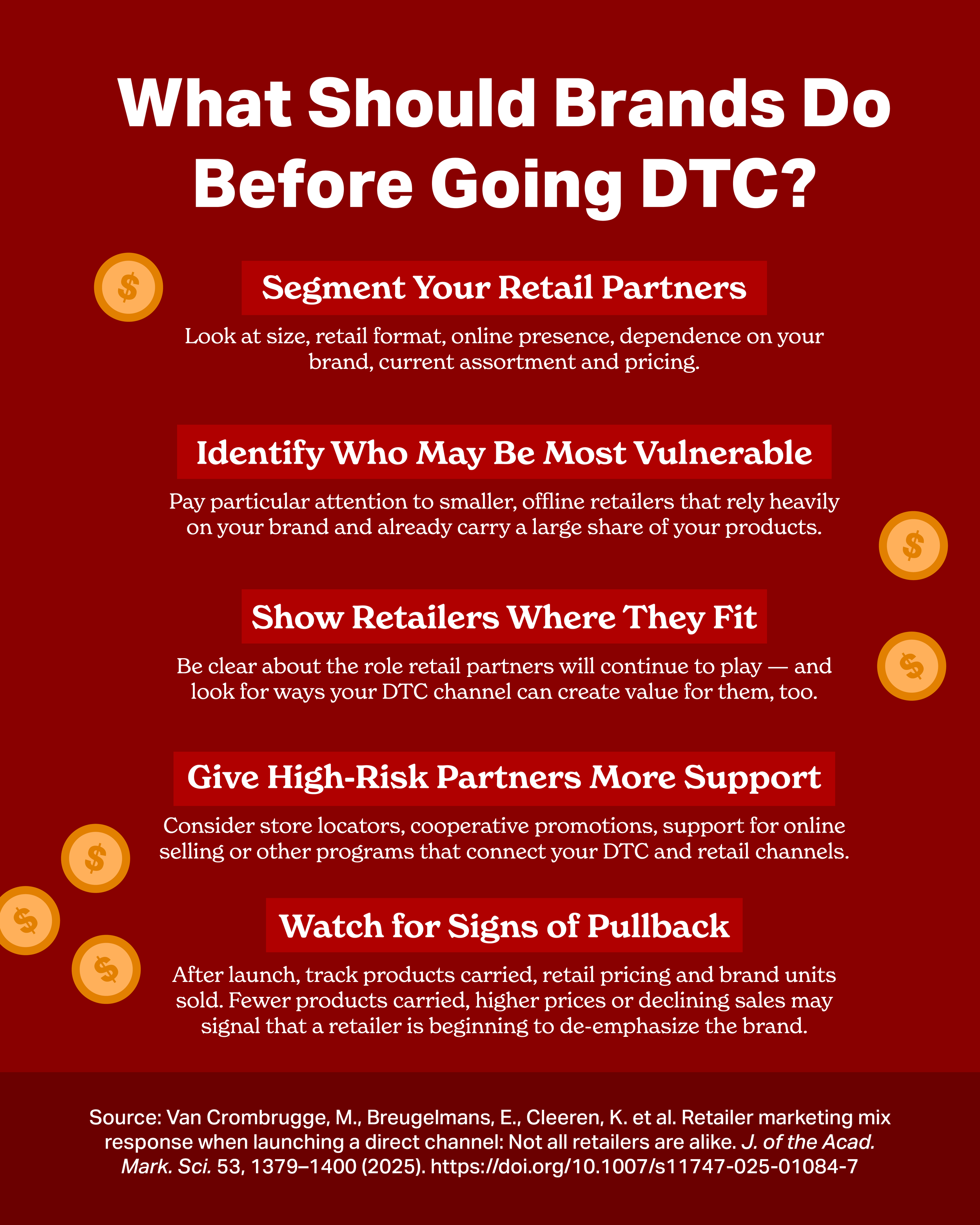
Segment your retail network. Look beyond total retail sales and group partners based on size, format, online capabilities, brand dependence, assortment and pricing.
Prioritize the most vulnerable partners. Smaller or offline retailers that rely heavily on the brand may need more communication and support than large multichannel partners.
Make their role clear. Retailers may be more likely to pull back if they are unsure where they fit once the manufacturer starts selling directly. Be explicit about how retail partners remain part of the broader channel strategy.
Create value across channels. Store locators can direct consumers from the manufacturer’s website to nearby retailers. Cooperative promotions can give partners a stronger incentive to continue supporting the brand. Manufacturers may also be able to help smaller retailers strengthen their own online capabilities. Brands can also explore arrangements such as in-store pick-up, where the direct channel helps generate traffic for retail partners.
The researchers modeled the potential effect of giving the primarily offline mom-and-pop segment an online channel. Their projected decline in brand sales fell from roughly 35.8% to 16.4%. This was a modeled scenario, not an observed intervention, but it suggests that helping vulnerable partners become more competitive across channels could reduce some of the downside associated with DTC entry.
Monitor retailer behavior after launch. Sales may not be the first sign of a changing relationship. Reductions in the number of products carried or increases in retail prices can signal that a partner is beginning to de-emphasize the brand.
Look beyond DTC sales alone
The research also points to a broader measurement issue. A brand can see strong performance in its new direct channel while simultaneously losing assortment, visibility or sales through established retailers. Evaluating the DTC channel in isolation could therefore miss important changes elsewhere in the business. The researchers could not calculate the manufacturer’s overall profitability because they did not have direct-channel sales or wholesale-price data. The study also examines one manufacturer and its first year following DTC entry, so the results should not be treated as a universal forecast for every brand or category.
But the practical question it raises is valuable: How did the DTC launch affect the entire channel system — not just sales through the new channel?
Your DTC strategy needs a retailer strategy
Going direct changes more than the path between a brand and a customer. It can also change how much retail partners stock, promote and sell the brand. The good news for marketers is that those reactions may be partly predictable. By understanding which partners are most vulnerable, brands can better target communication, incentives and support as they develop their DTC strategy.
About the Research
Retailer Marketing Mix Response When Launching a Direct Channel: Not All Retailers Are Alike
Journal of the Academy of Marketing Science (JAMS); Volume 53 (2025)
Authors:
Citation:
Van Crombrugge, M., Breugelmans, E., Cleeren, K. et al. Retailer marketing mix response when launching a direct channel: Not all retailers are alike. J. of the Acad. Mark. Sci. 53, 1379–1400 (2025). https://doi.org/10.1007/s11747-025-01084-7
From the Authors
What specific relevant marketing challenge(s) does your article address?
Many brands (such as Dyson, Nike, or Microsoft) invest in their own direct sales channels – typically webshops – while continuing to sell via multibrand retailers. This turns brands and retailers from partners into partners-and- competitors. The key managerial challenge for brands is to anticipate how their retail partners will respond to their direct selling practices in order to preserve performance of the brand in the retail channel. Therefore, specifically, we address:
How do retailers change their marketing mix (assortment and price) in response to a brand’s direct channel launch? Do they change their assortment of the brand, change the brand’s prices, or both?
Which retailers respond the most, and is this predictable based on observable retailer characteristics?
How does this translate into (losses or gains in) total brand sales at retailers?
What targeted actions can brands take to prevent suboptimal retailer responses to a direct channel launch?
Provide precise examples of companies/organizations/industries that will benefit from your findings?
Our findings are relevant for:
Any firm deciding whether to go direct with its brand(s). Will it be worth it? How should it be implemented?
Any firm whose partner-firm has decided to go direct with its brand(s). How should it react?
This includes, for instance:
Consumer electronics brands (e.g., Dyson, Sony)
Sportswear/outdoor brands (e.g., Nike, Adidas, YETI)
Beauty and personal care brands (e.g., Chanel, Burt’s Bees)
FMCG brands (e.g., PepsiCo)
All retail partners across different formats (e.g., large multichannel specialists, big generalists, independent specialty 'mom-and-pop' stores, etc.).
Using one of the entities listed above, illustrate how and to what extent it may benefit.
Our article features an empirical study of a global consumer electronics brand that introduced an online direct channel in a European country (e.g., a brand like Bose, Dyson or Bosch). In our data, the average retailer responds by decreasing the brand's assortment and increasing its price. Average total retailer sales of the brand decrease by 14.7% in the year after the direct channel entry. However, not all retailers respond in the same way and there is clear heterogeneity across retail formats. For instance:
Mom-and-pop electronics stores react most strongly to the direct channel entry; they decrease assortment the most (on average by −14.03%), increase price the most (+ 4.82%), and experience the largest decrease in sales (−35.84%).
Electronics chains, in contrast, increase their assortment (+ 1.87%), and increase price the least (+ 1.44%). Overall, they gain sales of the focal brand after direct channel entry (+ 6.05%).
We show that brands can predict retailers’ responses on the basis of measurable retailer characteristics, which increases their opportunity for a segmentation strategy and retailer-specific actions. For instance, our analysis suggests the brand would need to take actions to convince especially mom-and-pop stores of the benefits of a direct channel and/or to lower their concerns about the direct channel, to avoid their suboptimal response. These could be, for instance, “store locator” links on the brand’s own online channel to funnel consumers to mom-and-pop stores. Or they could launch cooperative promotional programs that give these stores stronger incentives to promote the brand. Brands can also help these stores develop their own multichannel strategy. Our calculations suggest adding an online channel for the mom-and-pop segment will cut in half the sales decline they will otherwise experience (from 35.8% decline to a 16.4% decline).
How can the recommendations from your findings be implemented?
We propose a series of steps for brands to take.
Recognize that investments in direct selling recalibrate the retail market, both in marketing mix and retailer sales.
Segment retailers using observable metrics (size, format, multichannel, brand share, current price/assortment position).
Flag the retailers most likely to respond disadvantageously based on their exposure to the value-creation and value-capture mechanisms of the direct channel (in our setting: retailers that are small, offline, highly brand-dependent, and already carrying many of the brand’s SKUs at premium prices).
Implement the direct channel with an explicit goal to avoid conflict. For example, keep a price umbrella, and be explicit about retailers' role within the brand’s channel portfolio.
Run targeted relationship-building programs at retailers where risks of disadvantageous responses are highest.
What outcomes would be expected?
Without a segmentation strategy and retailer-specific actions, brands should expect, on average, decreases in the brand's assortment, increases in its price, and decreases in sales at multibrand retail stores. This would diminish their competitiveness in these stores, and create room for competitor brands to sweep in. However, with a segmented approach, brands should see less of this “quiet quitting” of the brand after a direct channel entry, i.e., fewer SKU cuts, smaller price hikes, and more stable retail sales. This would protect brand visibility and distribution breadth.