
Turning Customer Insights Into Innovation
Marketers have access to more customer information than ever before. Surveys, website analytics, social conversations, interviews, purchase data and customer feedback can all tell us something about the people we are trying to reach.
But having customer data is not the same as having customer insight. That distinction is at the center of “Customer Insights for Innovation: A Framework and Research Agenda for Marketing,” by Stefan Stremersch, Elke Cabooter, Ivan A. Guitart and Nuno Camacho, published in the Journal of the Academy of Marketing Science.
The authors set out to bring more clarity to a field that had become fragmented across marketing, innovation, strategy and entrepreneurship. They reviewed 284 academic articles published over roughly 50 years, then organized the existing literature into 10 major areas of customer insights for innovation.
They also conducted 12 in-depth interviews with executives from major market research firms and surveyed 305 U.S. managers working in marketing, innovation, strategy and customer experience to validate the framework and better understand how customer insights are being used in practice.
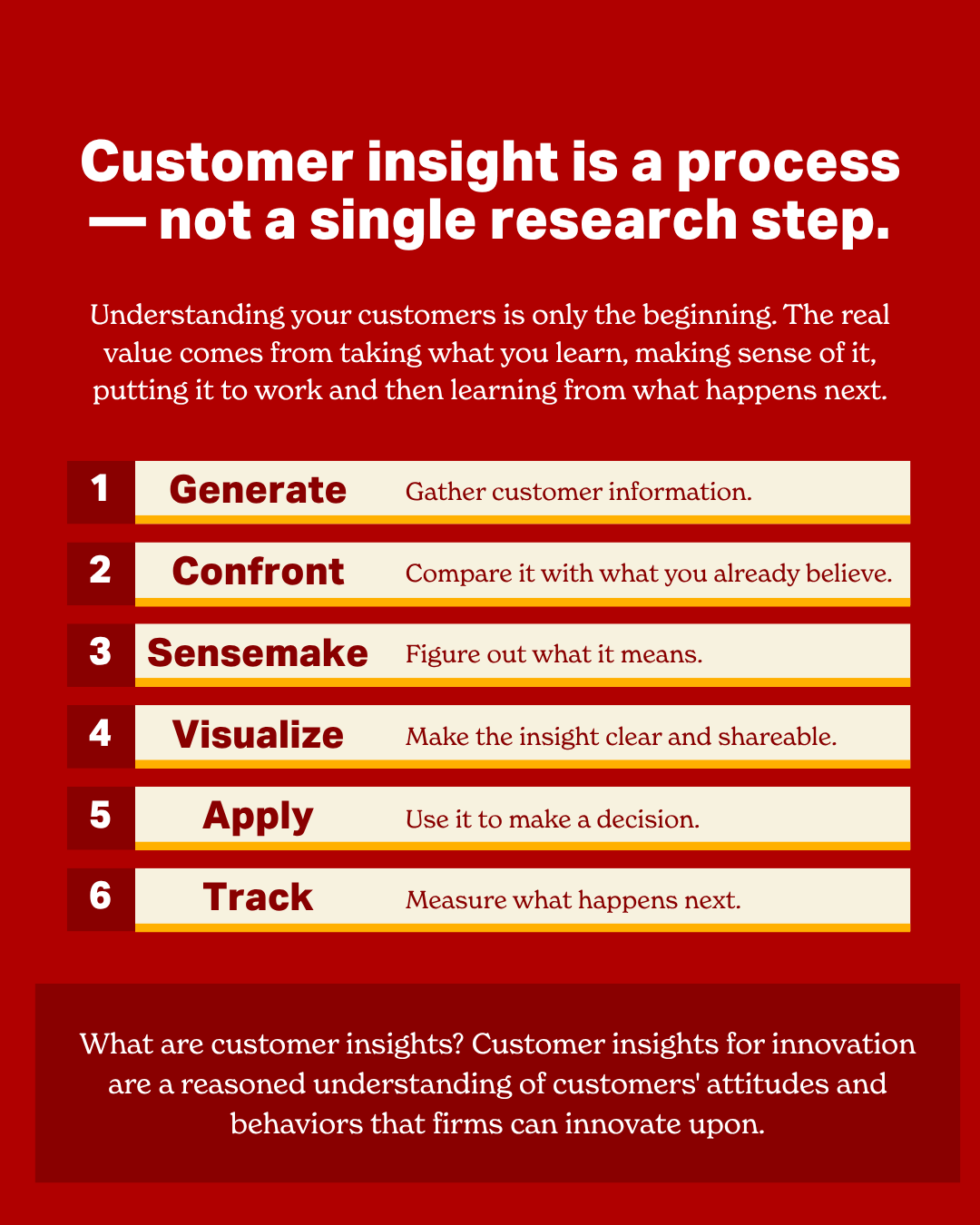
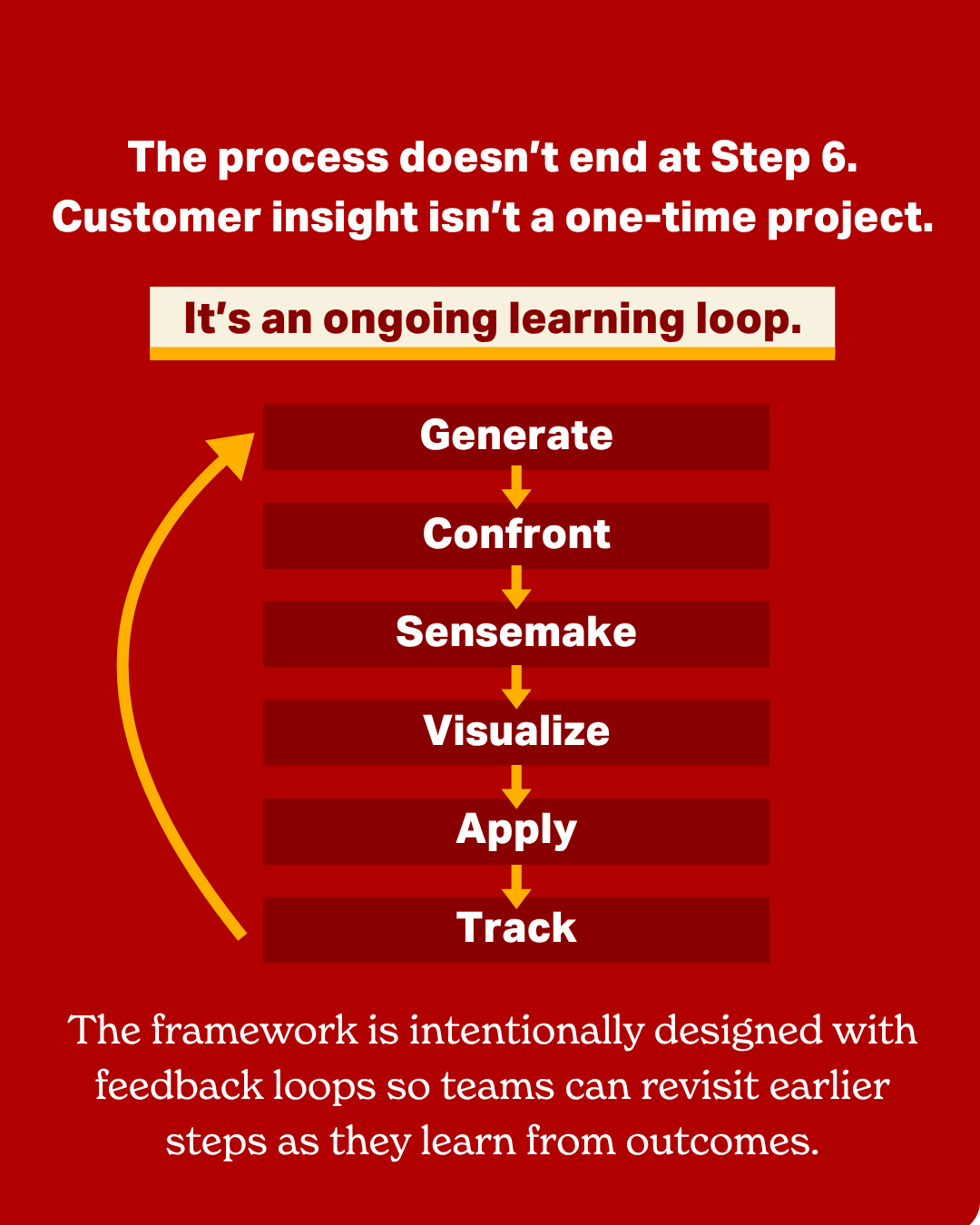
One of the study’s central contributions is a practical way to think about customer insight as a process. Rather than treating research as a one-time activity, the framework shows how organizations can move from gathering customer information to interpreting it, communicating it, acting on it and learning from what happens next.
That process includes six steps:
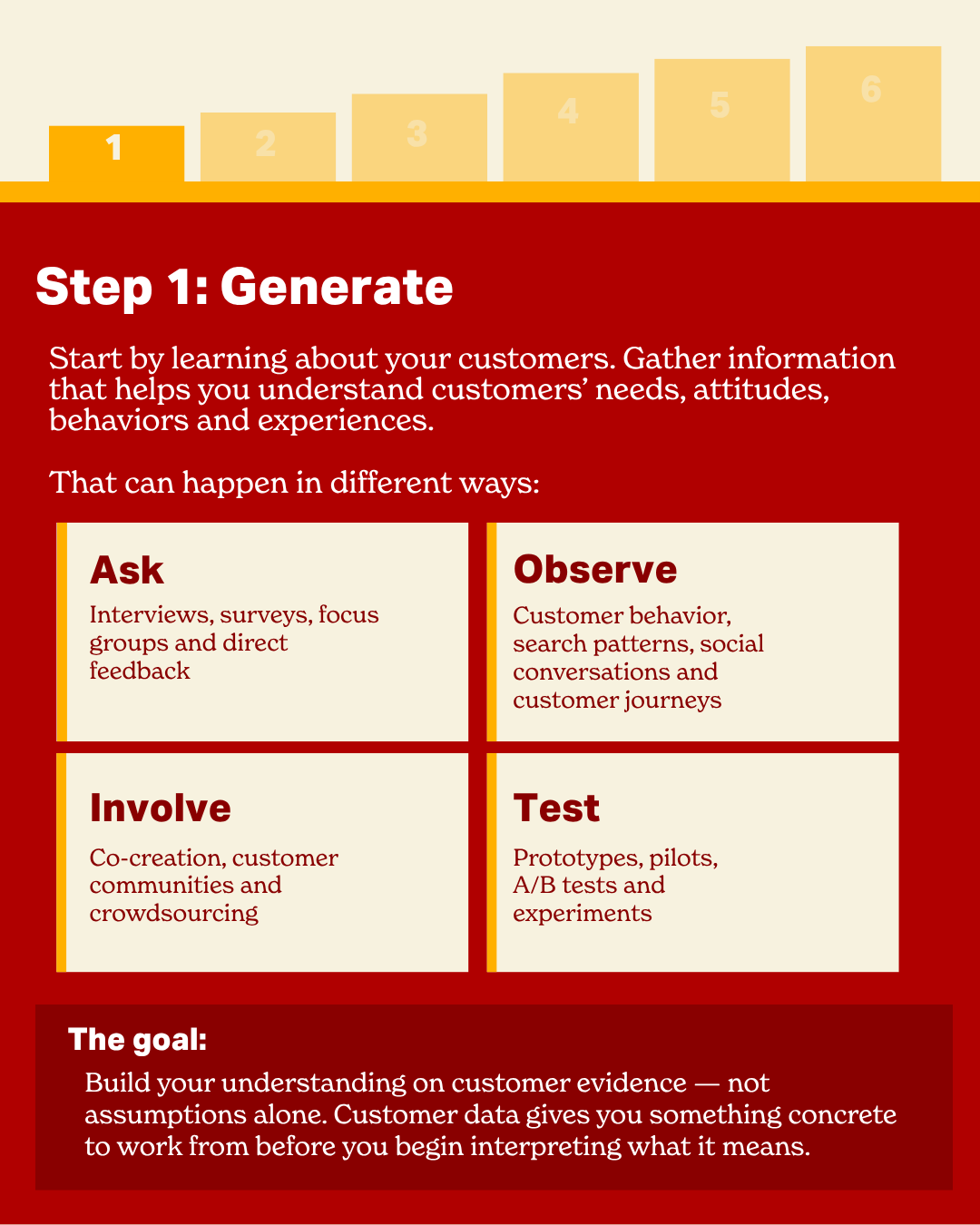
Step 1: Generate
Start by learning about your customers. Every insight begins with information. The goal at this stage is to develop a stronger understanding of customers’ needs, attitudes, behaviors and experiences.
There is no single way to do that. Marketers can ask customers directly through interviews, surveys, focus groups or other feedback. They can observe behavior through customer journeys, digital activity, search patterns or online conversations. They can involve customers through co-creation, customer communities or crowdsourcing. They can also test ideas through prototypes, pilots, A/B tests and experiments.
Each approach can reveal something different. Direct feedback can help explain what customers think or say they need. Observation can reveal behaviors customers may not think to mention. Co-creation allows customers to become active participants in developing ideas. Testing gives marketers an opportunity to see how customers respond to something more tangible.
The key is to begin with evidence rather than assumptions. Customer information gives marketers something concrete to work from before deciding what it means or what should happen next.
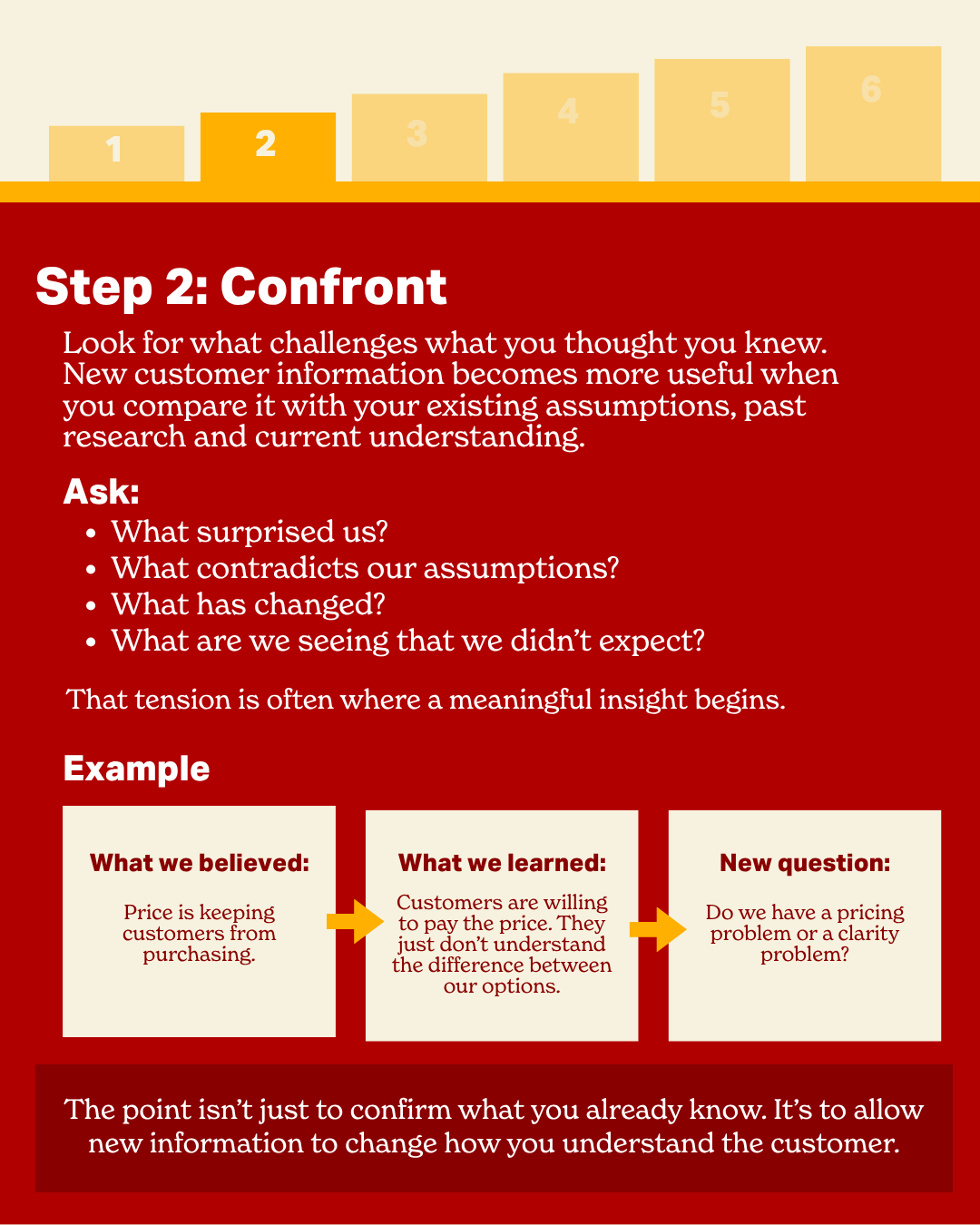
Step 2: Confront
Look for what challenges what you thought you knew. Once new information has been collected, the next step is not simply to add it to a report. It is to compare that information with what the organization already believes about its customers.
That means looking for tension. What surprised us? What contradicts our assumptions? What has changed? What are customers doing that we did not expect
Consider a company that assumes customers are not purchasing because its product is too expensive. New customer feedback may reveal that customers are actually comfortable with the price but do not understand the difference between the company's available options. That changes the question entirely. Instead of asking, “How do we make this more affordable?” the organization may need to ask, “How do we make the differences between these options clearer?” This is an important part of developing customer insight because the goal is not simply to confirm what an organization already thinks it knows. New information should have the opportunity to challenge existing assumptions and change how the customer is understood.
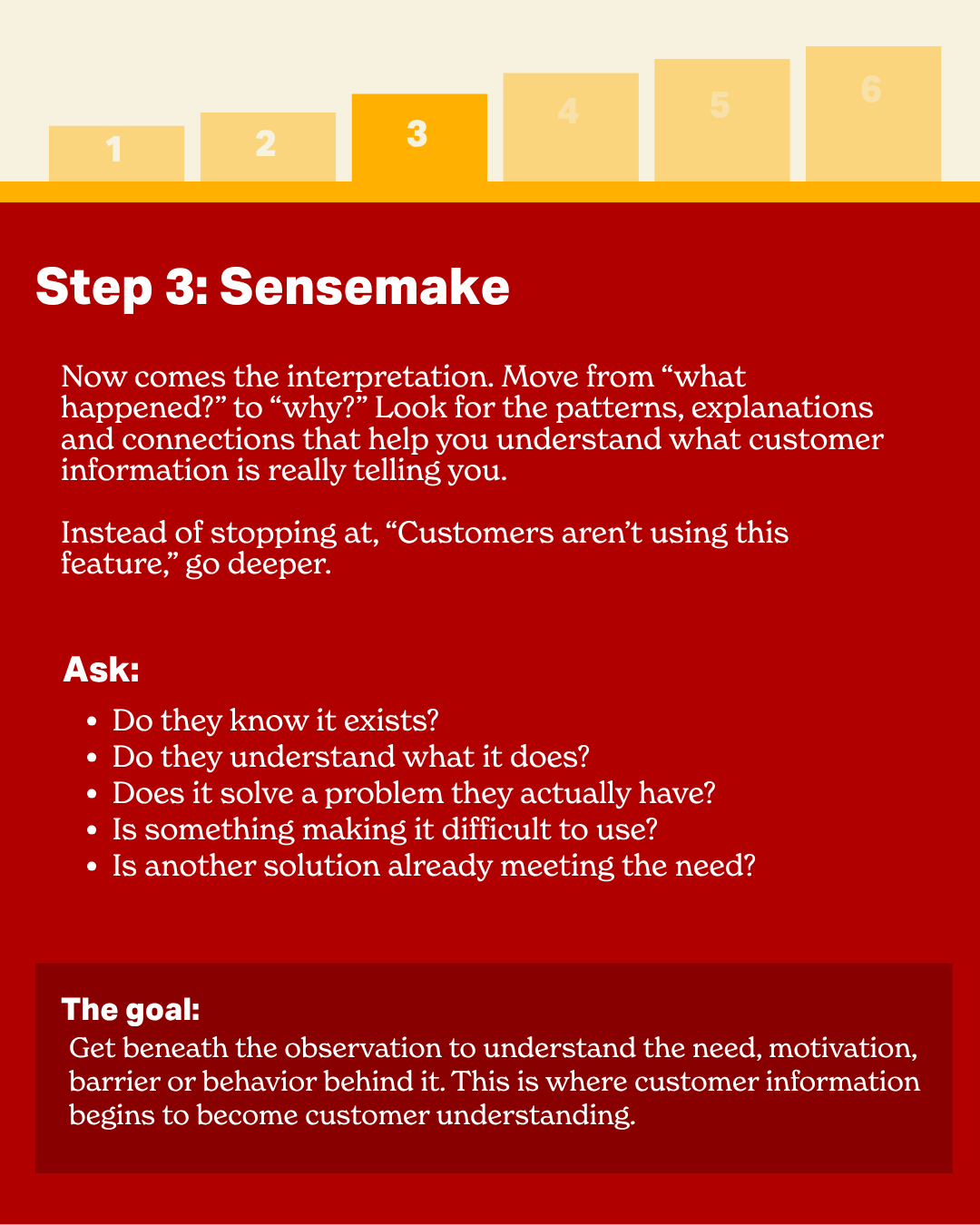
Step 3: Sensemake
Move from “what happened?” to “why?” Recognizing a pattern or behavior is useful, but it is not always an insight on its own. Suppose the data shows that customers are not using a particular feature. That tells marketers what is happening. Sensemaking requires going further.
Do customers know the feature exists? Do they understand what it does? Does it solve a problem they actually have? Is it difficult to use? Is another product or workaround already meeting the same need? These questions help marketers move beneath the observation to identify the need, motivation, barrier or behavior behind it.
This step also benefits from looking across different sources of information. Analytics may show where customers leave an experience. Interviews may help explain why. Customer service conversations may reveal recurring frustrations. Together, those sources can create a much more complete picture than any one piece of information could provide on its own. The objective is not simply to find an interesting statistic. It is to develop an explanation that improves the organization's understanding of the customer.
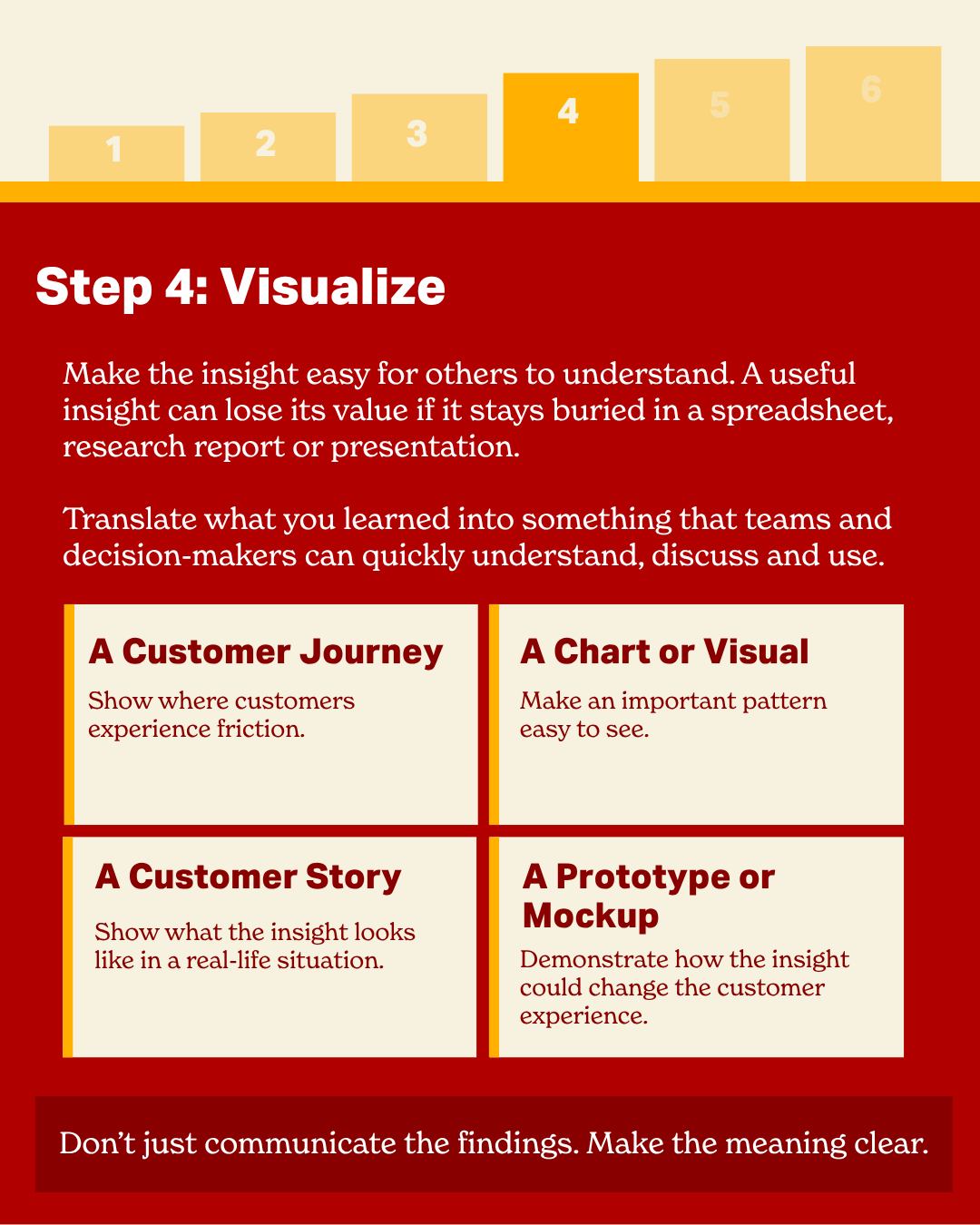
Step 4: Visualize
Make the insight easy for others to understand. Even a strong insight has limited value if it stays buried in a spreadsheet, lengthy research report or presentation that only a few people see. Marketers also have to translate what they have learned into something other people can quickly understand, discuss and use.
That might be a customer journey showing where people encounter friction. A chart or visual might make an important behavioral pattern immediately apparent. A customer story can demonstrate what an insight looks like in a real-world situation. A prototype or mockup can show how applying the insight might change an experience.
Visualization does not have to mean literally turning everything into a graph. Storytelling can be just as valuable. The goal is to communicate the meaning behind the information in a way that helps others understand why it matters. That is particularly important when insights need to travel across teams. Product, marketing, sales, customer experience and leadership may all need to understand the same customer need before an organization can effectively respond to it.
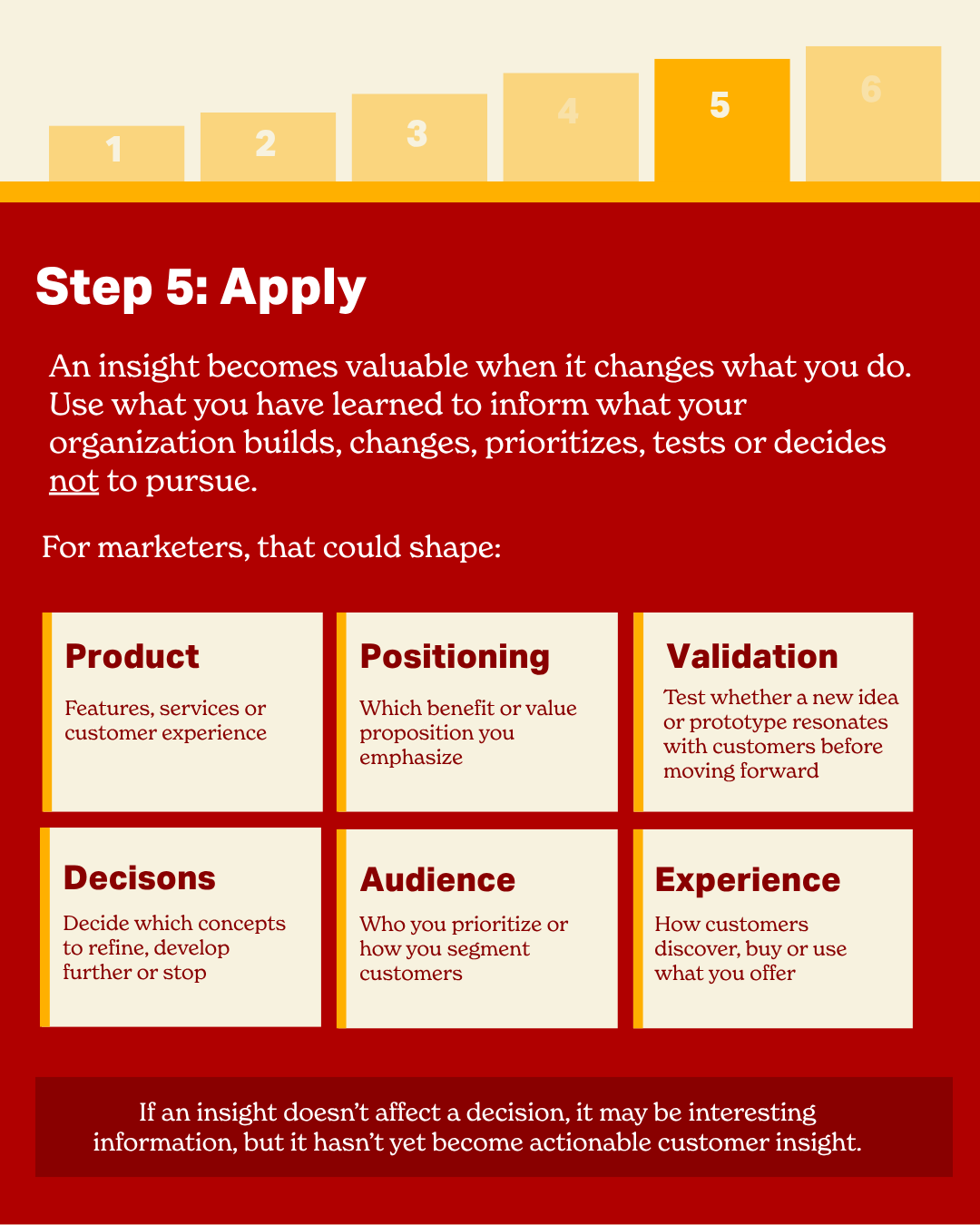
Step 5: Apply
Turn understanding into a decision. This is where customer insight becomes actionable. An insight should help an organization decide what to build, change, prioritize, test, or sometimes what not to pursue.
For marketers, that understanding can influence many different parts of the customer experience. It might shape the product, including features, services or functionality. It could change positioning by revealing which benefit customers value most. It may influence messaging by showing what customers need explained more clearly. It can affect audience strategy, including who should be prioritized or how customers are segmented. And it can lead to changes in the overall experience, from how customers discover an offering to how they purchase and use it.
A useful question at this stage is: What decision should be different because we know this? If nothing changes as a result of the information, it may still be interesting. But it has not yet fulfilled the most important role of customer insight: helping the organization make a better decision. This is also where marketers can play a broader role in innovation. Customer understanding should not only be used to determine how to promote something after it has been developed. It can help shape what gets developed in the first place.
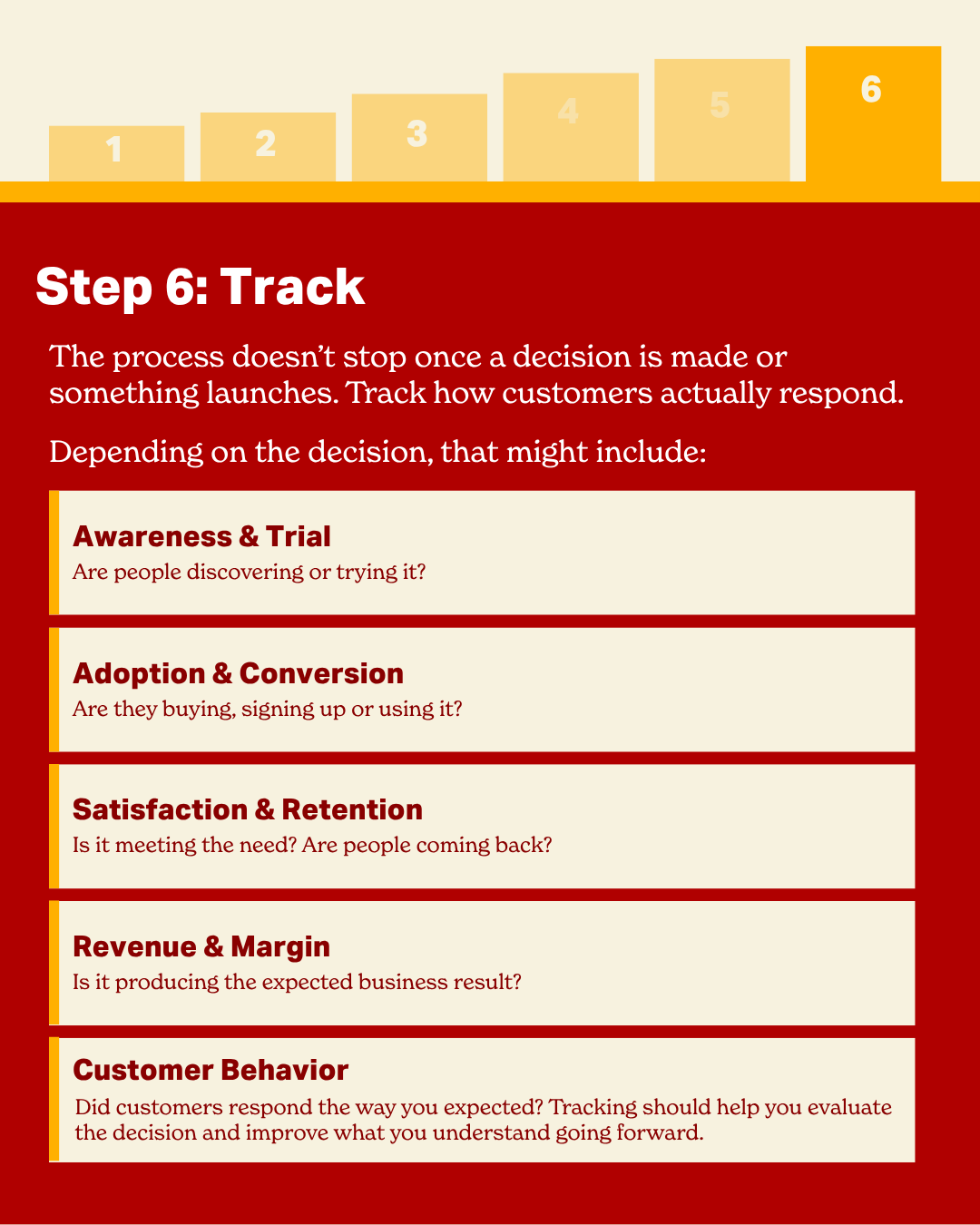
Step 6: Track
Find out what happened after you acted. Making a decision is not the end of the process. Once an idea is implemented, marketers need to understand how customers actually respond. The right measures will depend on the decision. Teams might track awareness and trial to determine whether customers are discovering an offering, or adoption and conversion to see whether they are actually buying, signing up or using it.
They may look at satisfaction and retention to understand whether the offering is meeting the customer's need over time. Revenue and margin can help evaluate business performance. And customer behavior itself can reveal whether people are responding in the way the organization expected.
But tracking is not simply about declaring something a success or failure. It should answer two questions: Did our decision produce the outcome we expected? And, what does what happened teach us about the customer now? The answer may validate the original insight. It may reveal that the organization misunderstood part of the customer need. Or it may uncover an entirely new question worth exploring.
Customer insight is an ongoing learning loop. That is why the process does not really end with Step 6. Treating customer insight as an ongoing loop gives marketers a way to continually refine what they know instead of relying on a snapshot of the customer from one point in time. And that may be the most important takeaway of the entire framework.
Better customer insight is not simply about collecting more data. It is about building a stronger connection between what customers do, what marketers understand, what organizations decide and what they learn next. When that connection becomes part of the way an organization operates, customer insight can do more than explain the market. It can help shape what comes next.
About the Research
Customer insights for innovation: A framework and research agenda for marketing
Journal of the Academy of Marketing Science (JAMS); Volume 52 (2024)
Authors:
Citation:
Stremersch, S., Cabooter, E., Guitart, I.A. et al. Customer insights for innovation: A framework and research agenda for marketing. J. of the Acad. Mark. Sci. 53, 29–51 (2025).
https://doi.org/10.1007/s11747-024-01051-8
Download the research >
From the Authors
What specific relevant marketing challenge(s) does your article address?
Many firms struggle to effectively translate customer insights into innovation outcomes, particularly during the fuzzy front end of the innovation process. Rather than fully leveraging the “voice of the customer” (VoC), organizations often rely predominantly on internal intuition and R&D-driven (technology-push) logic, which contributes to elevated new-product failure rates. Research based on interviews with 12 market research executives and a survey of more than 300 managers in marketing, innovation, and customer experience roles sheds light on why firms struggle to apply customer insights and how they can become more customer-centric. Notably, while approaches involving active customer participation, such as crowdsourcing and co-creation, are strongly linked to innovation performance, they remain underutilized, representing a significant opportunity for improvement.
Provide precise examples of companies/organizations/industries that will benefit from your findings?
Innovation-intensive firms across consumer goods, services, tech, B2B, and SMEs, especially organizations developing new products, services, or business models, and who want to engage in early-stage validation of their innovations. For instance, SMEs and startups often rely on founder intuition rather than structured customer insight processes. Life sciences and financial services firms provide another example: in these firms, a product-centric mindset often still dominates, and customer insights are perceived as slow or redundant.
Using one of the entities listed above, illustrate how and to what extent it may benefit.
Take the example of a Swiss insurer developing innovative products. After an ideation workshop, one team developed a novel insurance policy for pet owners. The question was how attractive the new policy was for its prospective customers. To answer this, the company conducted customer interviews (confronting) and leveraged the results to extract valuable conclusions about customers’ needs and willingness to pay (sensemaking). The concept was then visualized through storytelling for stakeholders. After a second round of concept tests with target customers, they launched the best product configuration (application) and tracked its performance over time (tracking). This approach enabled the insurer to create a product that truly resonated with customers, proving the value of a structured customer insights process in driving innovation success.
How can the recommendations from your findings be implemented?
We offer a six-step customer insights process that helps firms implement our recommendations:
Generate customer data early on (e.g., crowdsourcing, early-stage observation)
Effectively confront new data with prior beliefs
Engage in ‘sensemaking’ across functions
Visualize insights for better communication (e.g., mock-ups, storyboards)
Require decision-makers to base decisions on customer insights
Continuously track post-launch outcomes to refine future insights
What outcomes would be expected?
Better alignment between innovation concepts and customer needs
Faster and more confident go/no-go decisions
Reduced reliance on intuition when making innovation decisions
Higher innovation performance relative to competitors